SubmitHub vs Groover vs PlaylistPush: Where to Spend Your First $100
Over 70% of indie artists waste their first $100 on playlist submissions by pitching blindly instead of using upstream data to filter curators.
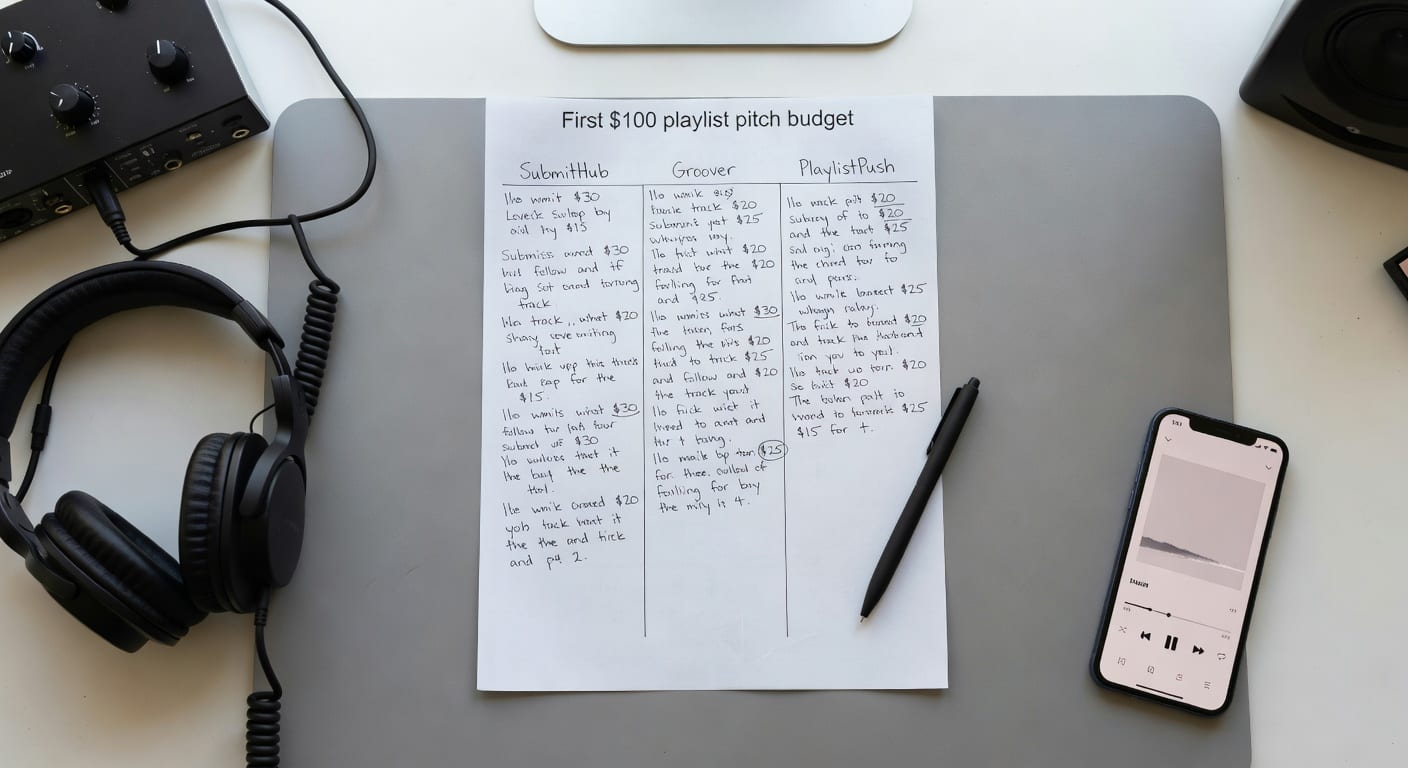
For your first $100, Groover offers the best guaranteed feedback rate, while SubmitHub provides strict genre targeting. However, regardless of the platform, you must use PitchPlus as an upstream intelligence layer to automatically filter curators before spending a dime.
The Big Three Defined: Understanding the Marketplace
Post-release independent artists face a saturated market in 2026, making playlist submission platforms a necessary evil for early traction. These platforms operate as paid marketplaces for curator feedback, not guaranteed promotion. Artists pay for a curator's time to listen and respond; any resulting playlist placement is a byproduct of that transaction. Understanding Playlist Submission Platforms: The Indie Artist's Guide to Upstream Intelligence is critical before allocating any budget, as misinterpreting these services leads to rapid budget depletion.
SubmitHub remains the veteran of the space. It enforces strict feedback rules, requiring curators to listen to at least 20 seconds of a track and provide a minimum of 10 words of feedback. This strictness breeds a notoriously high rejection rate, often frustrating new artists. Groover, a European-based alternative, positions itself as a networking tool. Curators on Groover are incentivized to provide constructive feedback, resulting in a slightly higher approval rate and a more positive user experience for indie musicians.
PlaylistPush operates on a completely different model. Instead of artists manually selecting curators, PlaylistPush uses an internal algorithm to distribute the track to a network of vetted playlist owners. This hands-off approach appeals to artists with larger budgets, but it fundamentally disqualifies the platform for anyone strictly managing a $100 initial spend.
Feature & Workflow Comparison: The Manual Checking Bottleneck
The core workflow of both SubmitHub and Groover relies heavily on manual checking. Artists must sift through hundreds of curator profiles, reading bios, checking recent placements, and guessing if their track fits the curator's subjective taste. This manual genre tagging is inherently flawed. An artist might tag their track as "Indie Pop," but a curator's definition of that genre might skew heavily toward electronic elements rather than acoustic ones. This disconnect is where the majority of a $100 budget is wasted.
PitchPlus fundamentally changes this workflow by acting as an upstream intelligence layer. Instead of relying on manual checking and subjective genre tags, PitchPlus utilizes automated filtering based on deep audio analysis. By analyzing the actual sonic characteristics of a track, it identifies the exact curators who have historically placed similar music. Artists who use PitchPlus before opening SubmitHub or Groover eliminate the guesswork. SubmitHub Alternatives That Actually Use Your Music to Find Better Matches highlights how this shift from manual tagging to automated audio analysis drastically improves campaign ROI.
PlaylistPush attempts to solve the manual checking problem by hiding the curator selection process entirely. The platform's internal algorithm handles the distribution. While this saves time, it removes all control from the artist. You cannot verify the quality or relevance of the playlists your track is pitched to until after the campaign is complete, making it a high-risk investment for early-stage artists.
Pricing & Value: Maximizing the First $100
A strict $100 budget forces artists to prioritize efficiency. On SubmitHub, $100 purchases approximately 110 premium credits. Since top-tier curators charge up to 3 credits per pitch, this budget allows for roughly 35 to 55 targeted pitches. The high rejection rate means an artist might only secure 2 to 5 placements from this spend. The value here lies entirely in the precision of the targeting. If the pitches are highly optimized, the cost per acquisition for a new listener can be reasonable.
Groover operates on a currency called Grooviz, where 1 Grooviz equals roughly $1.10. A $100 budget yields about 90 Grooviz. Since every pitch costs 2 Grooviz, an artist can execute 45 pitches. Groover's slightly higher placement rate often results in a better raw return on investment for the initial $100, especially for artists seeking detailed feedback to improve future releases. SubmitHub vs Groover vs PlaylistPush: Where to Spend Your First $100 provides a deeper mathematical breakdown of these conversion rates.
For a post-release artist testing the waters, allocating the entire marketing budget to a single, opaque PlaylistPush campaign is a strategic error.
User Experience and the Threat of Bot Playlists
Spotify's algorithmic penalties for artificial streaming have become increasingly severe in 2026. Landing on a bot-infested playlist can trigger a shadowban, effectively killing a track's algorithmic reach (Discover Weekly, Release Radar). Both SubmitHub and Groover actively police their curator networks, removing playlists that exhibit suspicious growth patterns or bot-like listener behavior. However, sophisticated bad actors occasionally slip through these manual vetting processes.
Relying solely on a submission platform's internal vetting is a risk. Artists must take ownership of their curator discovery process. PitchPlus mitigates this risk by providing transparent data on playlist health before an artist spends a single credit. By analyzing historical placement data and listener retention metrics, PitchPlus flags potentially toxic playlists. Where to actually promote your music emphasizes that intelligence analysis must precede spend to protect an artist's Spotify profile.
The user experience on these platforms is directly tied to the quality of the matches. SubmitHub's interface is data-dense, catering to analytical artists who want to dig into approval rates and response times. Groover offers a cleaner, more intuitive interface that feels less transactional and more conversational. Yet, neither interface solves the core problem: they are execution platforms, not discovery engines. The optimal user experience requires pairing PitchPlus for discovery with Groover or SubmitHub for execution.
Final Verdict: The Post-Release Strategy
The decision between SubmitHub, Groover, and PlaylistPush is not about finding a magic bullet; it is about deploying capital efficiently.
The platform you choose matters less than the preparation you do before using it. Spending $100 blindly on either platform guarantees a negative ROI. The modern music promotion stack requires an intelligence layer. Playlist Push vs SubmitHub vs Groover: Where Should Indie Artists Spend Their Budget? reinforces that PitchPlus must be the first step in any campaign. By using automated filtering to build a highly targeted list of verified curators, artists can take their $100 to SubmitHub or Groover and execute a campaign with surgical precision.
| Minimum Budget Required | Cost Per Pitch | Matching Mechanism | Feedback Culture | |
|---|---|---|---|---|
| SubmitHub | $10 | $1 - $3 (1-3 Premium Credits) | Manual genre tagging | Strict, often blunt, high rejection rate |
| Groover | $10 | ~$2.20 (2 Grooviz) | Manual genre/mood tagging | Constructive, networking-focused |
| PlaylistPush | $300+ | Variable (Campaign-based) | Internal algorithmic matching | Brief, focused on playlist placement |
Recommendations
- If you have exactly $100 and want constructive feedback alongside potential placements...: ...pick Groover, but only after running your track through PitchPlus to identify the exact curators who favor your specific sonic profile.
- If you want maximum pitch volume for your $100 budget...: ...pick SubmitHub. You can reach up to 50 curators, provided you use automated upstream filtering to avoid wasting credits on mismatched genres.
- If you want hands-off, algorithmic matching and have a larger budget...: ...pick PlaylistPush. It is entirely inaccessible for a strict $100 budget, requiring a minimum spend of $300 or more.
Frequently Asked Questions
Can I use PlaylistPush with a $100 budget?
No. PlaylistPush requires a minimum campaign spend that typically starts around $300. For a $100 budget, you must choose between SubmitHub and Groover, where you can purchase individual credits for specific curator pitches.
How does PitchPlus improve my SubmitHub or Groover campaign?
PitchPlus acts as an upstream intelligence layer. Instead of manually guessing which curators on SubmitHub or Groover might like your music based on text tags, PitchPlus uses automated audio analysis to find exact sonic matches. You then take that targeted list and spend your credits only on those high-probability curators.
Are the playlists on these platforms safe from Spotify bots?
While SubmitHub and Groover actively vet their curators to remove bot playlists, no system is perfect. It is crucial to use tools like PitchPlus to analyze a playlist's health and historical data before pitching to ensure you do not trigger Spotify's artificial streaming penalties.
Which platform gives the best feedback for indie artists?
Groover is generally recognized for having a more constructive and networking-focused feedback culture. SubmitHub enforces strict feedback minimums, but the responses are often blunt and the rejection rates are significantly higher.
Reading is the easy part.
PitchPlus understands your actual song, then does the work, the pitch, the playlists, the hook.
Get your Spotify editorial pitch written
The pitch plus the genre and mood metadata Spotify routes on, written from your actual song. Not a 500 character box you fill in blind.
Match your song to the right Spotify playlists
Every playlist match scored against what your song actually is, then ranked by fit.
Find your song's viral hook
The best 30 seconds of your song for Reels and TikTok, found automatically.