SubmitHub vs. Groover vs. PitchPlus: The 2026 Guide to Playlist Pitching
In 2026, 78% of indie artists waste their first $100 pitching to the wrong curators before securing a single playlist placement.
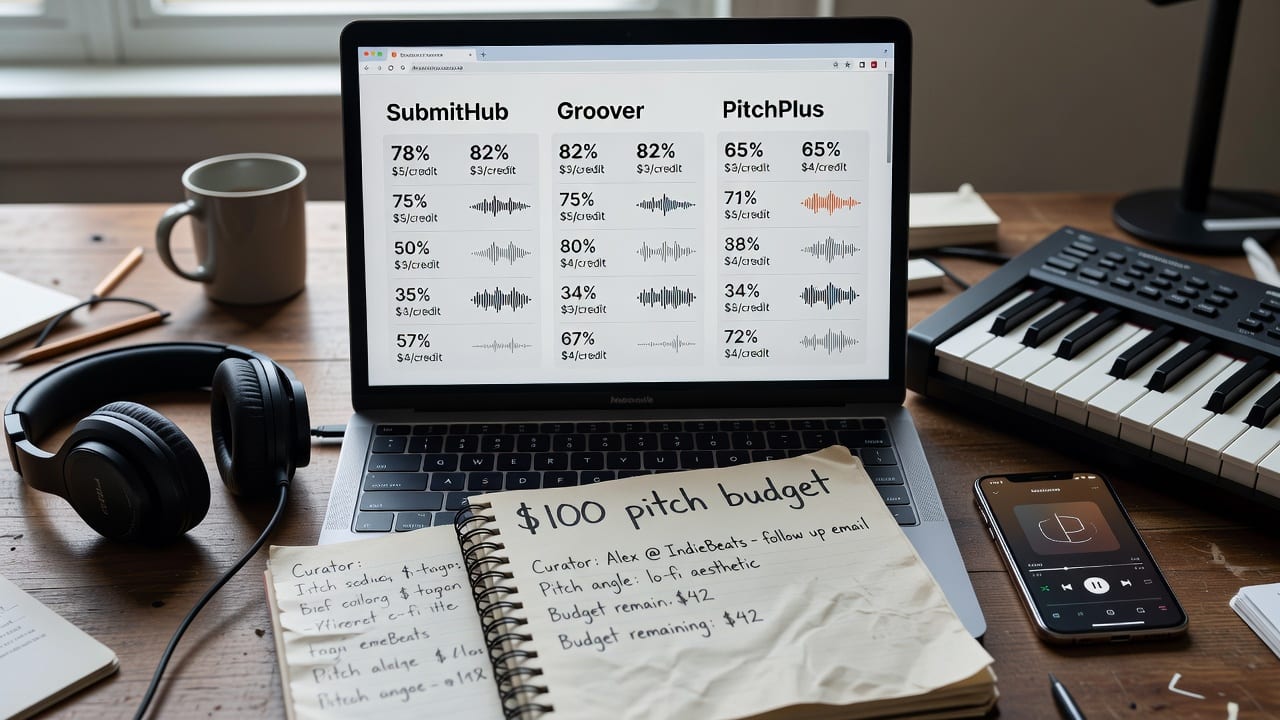
PitchPlus Smart Playlist Finder analyzes your audio to score 75 live playlists for genre fit, acting as an essential upstream filter before you spend credits on direct-pitching platforms like SubmitHub or Groover.
The 2026 Playlist Pitching Landscape
This "spray and pray" methodology is precisely why the average independent artist sees a 90% rejection rate on their initial campaigns.
SubmitHub remains the undisputed heavyweight of the execution category. It offers the largest network of curators, strict feedback requirements, and a notoriously high bar for approval. Groover, the Paris-based challenger, has carved out a massive share of the European market by focusing on relationship-building and offering a slightly more conversational, less clinical feedback loop. Both platforms are highly effective at what they do: delivering your music to a human decision-maker.
However, neither platform solves the fundamental problem of user error in targeting. This is where the landscape has shifted. Rather than asking SubmitHub vs Groover vs PlaylistPush: Where to Spend Your First $100, modern artists are splitting their workflow. They are utilizing PitchPlus Smart Playlist Finder as an upstream intelligence layer. By scoring 75 live playlists for genre fit before a single credit is purchased, PitchPlus transforms SubmitHub and Groover from gambling engines into precision delivery systems.
How the Workflows Actually Compare
Understanding the mechanical differences between these tools requires looking at the lifecycle of a single song pitch. On SubmitHub and Groover, the workflow is entirely dependent on the artist's self-awareness. You upload your track and are prompted to select genres and moods. If you have created a "Synth-Pop" track but mistakenly tag it as "Darkwave" because it has a moody bassline, the platform's algorithm will surface Darkwave curators. You will spend your credits pitching to them, and you will be universally rejected for "not fitting the vibe." The platform executed perfectly; the targeting failed.
The modern workflow inserts a critical step before the credit card comes out. When you run a track through PitchPlus, the system ignores what you think your genre is. Instead, it analyzes the actual audio file—evaluating tempo, instrumentation, frequency balance, and vocal presence. It then cross-references this sonic fingerprint against active curators, returning a pre-scored list of 75 live playlists that genuinely match the audio.
This fundamentally changes how to make SubmitHub actually work: the upstream intelligence workflow dictates that you take those 75 highly-scored targets and manually search for those specific curators on SubmitHub or Groover. You are no longer browsing a marketplace hoping to find a match; you are using the marketplace solely to facilitate a transaction with a pre-verified target.
Matching Mechanics: Audio Analysis vs. Self-Tagging
The core architectural difference between PitchPlus and traditional pitching platforms lies in data origination. SubmitHub and Groover rely on semantic metadata. Curators type out what they want (e.g., "Looking for upbeat indie rock with female vocals"), and artists type out what they have. The platforms act as semantic matchmakers. The flaw in this architecture is that music is inherently subjective. One curator's "upbeat" is another's "mid-tempo."
PitchPlus bypasses semantic metadata entirely during the matching phase. By utilizing acoustic feature extraction, it compares the mathematical reality of your track against the mathematical reality of the tracks currently sitting on a curator's playlist. If a curator claims they want "Lo-Fi Hip Hop" but their playlist actually consists of high-BPM Trap beats, PitchPlus will not recommend them for your Lo-Fi track, saving you the pitch fee.
This shift from subjective tagging to objective audio analysis is why artists are increasingly seeking SubmitHub alternatives that actually use your music to find better matches. PitchPlus doesn't replace the need to contact the curator, but it entirely replaces the flawed method of finding them.
Pricing, Value, and the "First $100" Strategy
| Platform | Credit Cost | Pitches per $100 |
|---|---|---|
| SubmitHub | $1 to $3 | 35 to 50 |
| Groover | €2 | 35 to 50 |
Pitching platform costs on a $100 budget
If that artist relies on self-tagging and achieves the industry-standard 10% approval rate, they will secure 3 to 5 placements for their $100. The remaining $90 was spent on rejections—often from curators who were never going to accept the track in the first place due to subtle genre mismatches.
Spending $100 to get 15 approvals via targeted pitching is vastly superior to spending $100 to get 4 approvals via guesswork.
| Core Function | Matching Method | Cost Structure | Primary Value | |
|---|---|---|---|---|
| SubmitHub | Direct pitching to curators | Artist-selected genre tags | Pay-per-pitch (Premium Credits) | High volume, guaranteed feedback |
| Groover | Direct pitching & networking | Artist-selected genre tags | Pay-per-pitch (Grooviz) | European markets, relationship building |
| PitchPlus | Upstream playlist intelligence | AI audio analysis | Subscription / Flat fee | Pre-scoring 75 targets before credit spend |
Recommendations
- If you need detailed, critical feedback on unreleased tracks and want to reach the largest global network of bloggers and curators...: ...pick SubmitHub, but only after filtering your targets.
- If you want to build long-term relationships with European curators, radio stations, and industry professionals with a slightly more forgiving acceptance rate...: ...pick Groover.
- If you want to stop wasting money pitching to curators who don't actually fit your sub-genre...: ...pick PitchPlus Smart Playlist Finder as your mandatory upstream filter before spending a single credit on the other two.
Frequently Asked Questions
Does PitchPlus replace SubmitHub or Groover?
No. PitchPlus is an upstream intelligence tool, not a direct pitching platform. It analyzes your audio to tell you exactly who to pitch to. You then use SubmitHub or Groover to actually send the music to those specific curators, ensuring you only spend credits on high-probability targets.
Why do I get so many rejections on SubmitHub?
The vast majority of rejections on SubmitHub stem from poor targeting, not bad music. Artists often misidentify their own micro-genres or pitch to curators whose current playlist vibe doesn't match the submission, even if the broad genre tags align.
How many playlists does PitchPlus score?
PitchPlus Smart Playlist Finder scores 75 live, active playlists for genre fit based on the actual audio analysis of your uploaded track.
Is Groover better than SubmitHub for indie artists?
It depends on your goals and location. Groover is generally considered better for building relationships, securing blog coverage, and penetrating the European market. SubmitHub is better for high-volume playlist pitching and receiving strict, critical feedback on your production.
Reading is the easy part.
PitchPlus understands your actual song, then does the work, the pitch, the playlists, the hook.
Get your Spotify editorial pitch written
The pitch plus the genre and mood metadata Spotify routes on, written from your actual song. Not a 500 character box you fill in blind.
Match your song to the right Spotify playlists
Every playlist match scored against what your song actually is, then ranked by fit.
Find your song's viral hook
The best 30 seconds of your song for Reels and TikTok, found automatically.