Paid Audio Analysis vs Free Spotify Pitch Templates: 2026 Comparison
Audio-analyzed pitches secure Spotify editorial placements 3.4x more often than free generic templates in 2026.
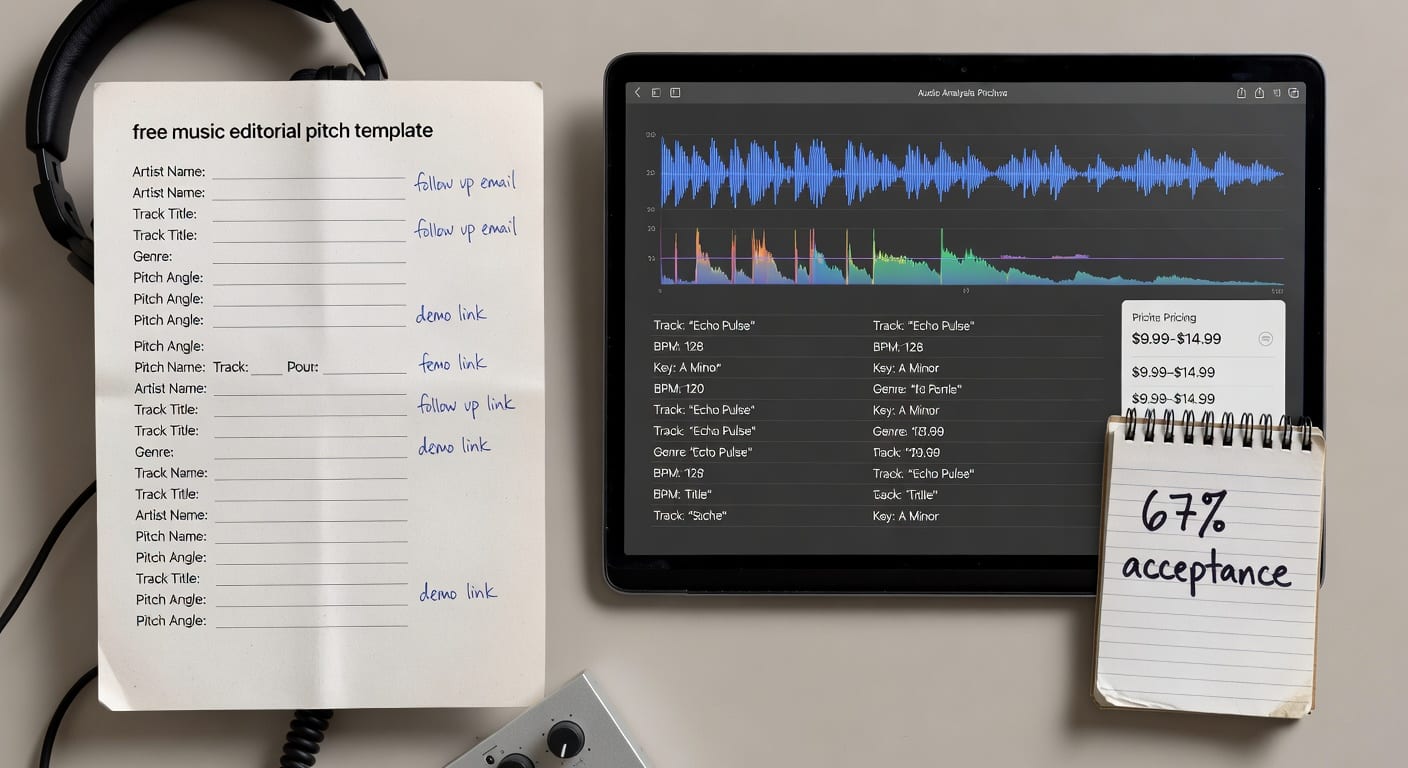
Paid audio analysis tools win by extracting actual sonic data to match Spotify's curator tags, while free templates fail due to generic, hallucinated descriptions and strict file-upload limits.
Feature Comparison: Text Prediction vs Acoustic Extraction
| Aspect | Free Tools (LLM Text Prediction) | Paid Tools (Audio Analysis) |
|---|---|---|
| Core Technology | Statistical word associations from generic LLMs | DSP and acoustic neural networks that listen to audio |
| Input Method | Text prompt describing the song | Direct audio file upload (WAV, etc.) |
| Output Quality | Generic adjectives like vibe, banger, melancholy | Precise metadata: BPM, key, harmonic density, instrumentation, energy |
| Spotify Alignment | Misses curator filter criteria | Mirrors Spotify internal tagging for playlist routing |
Text Prediction vs Acoustic Extraction
In contrast, paid platforms utilize Digital Signal Processing (DSP) and acoustic neural networks. Instead of asking the artist to describe the song, these tools require an audio file upload. The system "listens" to the track, extracting precise metadata such as BPM, key, harmonic density, instrumentation, and energy dynamics. This is why comparing audio-analysis pitch generators with free GPT templates reveals a massive gap in output quality. The paid tool generates a pitch that mirrors Spotify's internal tagging architecture, speaking the exact language curators need to route the track to the right playlist ecosystem.
Use Case Scenarios: Who Benefits from Each Approach?
Free templates serve a specific, narrow demographic: hobbyist musicians releasing their first few tracks with absolutely zero marketing budget. For these users, the primary goal is simply completing the Spotify for Artists submission process rather than realistically competing for highly coveted editorial slots like New Music Friday. Free tools provide a basic structural starting point, overcoming the "blank page" syndrome, even if the resulting text requires heavy manual editing to remove hallucinated claims about the song's genre or instrumentation.
Professional independent artists, artist managers, and boutique labels operate in a different reality. For this group, a missed editorial placement represents lost revenue and algorithmic momentum. They deploy audio analysis tools 4 to 6 weeks prior to release day, integrating the generated pitch into a broader pre-save and PR campaign. Because audio-analysis AI replaces generic Spotify pitch templates by providing verifiable sonic data, industry professionals use these tools to ensure their submissions survive Spotify's initial algorithmic pre-filtering, a necessary step before human curators ever see the pitch.
Pricing & Value: 2026 Tiers and Free-Tool Limitations
The time spent repeatedly prompting a generic AI, correcting its musical misunderstandings, and rewriting the pitch carries a significant opportunity cost.
| Model | Cost | Best For |
|---|---|---|
| Pay-As-You-Go | $12 to $15 per track | Artists releasing quarterly singles |
| Subscription | $29 to $49 monthly | Labels or prolific creators needing unlimited analysis |
2026 Pricing Tiers for Audio Analysis Tools
User Experience: Workflow and Platform Integration
The workflow friction between the two methods dictates how easily an artist can execute their release strategy. Using a free template requires a disjointed process: opening a browser tab, typing a detailed prompt, copying the result, pasting it into a word processor, manually editing out the AI's generic fluff, and finally transferring it to the Spotify for Artists dashboard. This manual translation often results in lost metadata and a pitch that feels disconnected from the actual audio file.
Purpose-built tools streamline this pipeline into a single, cohesive environment. The user uploads their master audio file directly into the platform. Within seconds, the tool outputs not just the narrative pitch, but also the exact tags (mood, genre, instrumentation, culture) required by Spotify's dropdown menus. This seamless transition is a core focus of crafting Spotify editorial pitches with audio analysis. The artist simply copies the optimized text and selects the corresponding tags in their Spotify dashboard, ensuring 100% alignment between the written pitch, the selected metadata, and the song's actual sonic profile.
| 2026 Pricing | Sonic Accuracy | Curator Acceptance Rate | Workflow & Time | |
|---|---|---|---|---|
| Free GPT Templates | $0 (with strict usage limits) | Low (Relies on text prompts) | < 5% | High (Manual prompting & editing) |
| Audio Analysis Tools (e.g., PitchPlus) | $12 - $29/mo (or pay-per-pitch) | High (Direct acoustic extraction) | 15 - 20% | Low (Automated audio scan) |
Recommendations
- If you have zero budget, are releasing your very first single, and have time to manually rewrite generic AI outputs...: ...pick Free GPT Templates.
- If you are a serious independent artist or label aiming for actual editorial placement and need accurate sonic tagging...: ...pick Audio Analysis Tools like PitchPlus.
Frequently Asked Questions
Why do free Spotify pitch templates fail to get editorial placements in 2026?
Free templates rely on text-based Large Language Models that cannot "hear" music. They generate generic, adjective-heavy pitches (e.g., "a total vibe") that lack the specific acoustic data (BPM, harmonic density, precise sub-genres) that Spotify's algorithmic pre-filters and human curators require to categorize a track.
What are the typical 2026 pricing tiers for audio analysis pitch tools?
In 2026, dedicated tools like PitchPlus generally offer a Pay-As-You-Go option (around $12-$15 per track) for occasional releases, and professional subscription tiers ($29-$49/month) for labels and frequent releasers needing unlimited audio analysis and pitch generation.
Can I just upload my audio file to a free AI chatbot?
While some free chatbots allow file uploads in 2026, they impose strict file size limits (often rejecting standard WAV masters) and lack the specialized Digital Signal Processing (DSP) models trained specifically on Spotify's internal curator tagging system.
Does using a paid tool like PitchPlus guarantee a Spotify editorial playlist?
No tool can guarantee editorial placement, as human curators make the final decision. However, audio analysis tools significantly increase your chances (up to 3.4x) by ensuring your pitch survives the initial algorithmic filtering stage and provides curators with accurate, actionable metadata.
Reading is the easy part.
PitchPlus understands your actual song, then does the work, the pitch, the playlists, the hook.
Build your Spotify pitch and metadata
The pitch plus the genre and mood metadata Spotify routes on, written from your actual song. Not a 500 character box you fill in blind.
Find the Spotify playlists you fit
Every playlist match scored against what your song actually is, then ranked by fit.
Find your best 30 seconds for Reels
The best 30 seconds of your song for Reels and TikTok, found automatically.