Spotify Editorial Pitch Generator vs Free Tools: Why Audio Analysis Beats GPT Templates
94% of Spotify editorial pitches are rejected by curators.
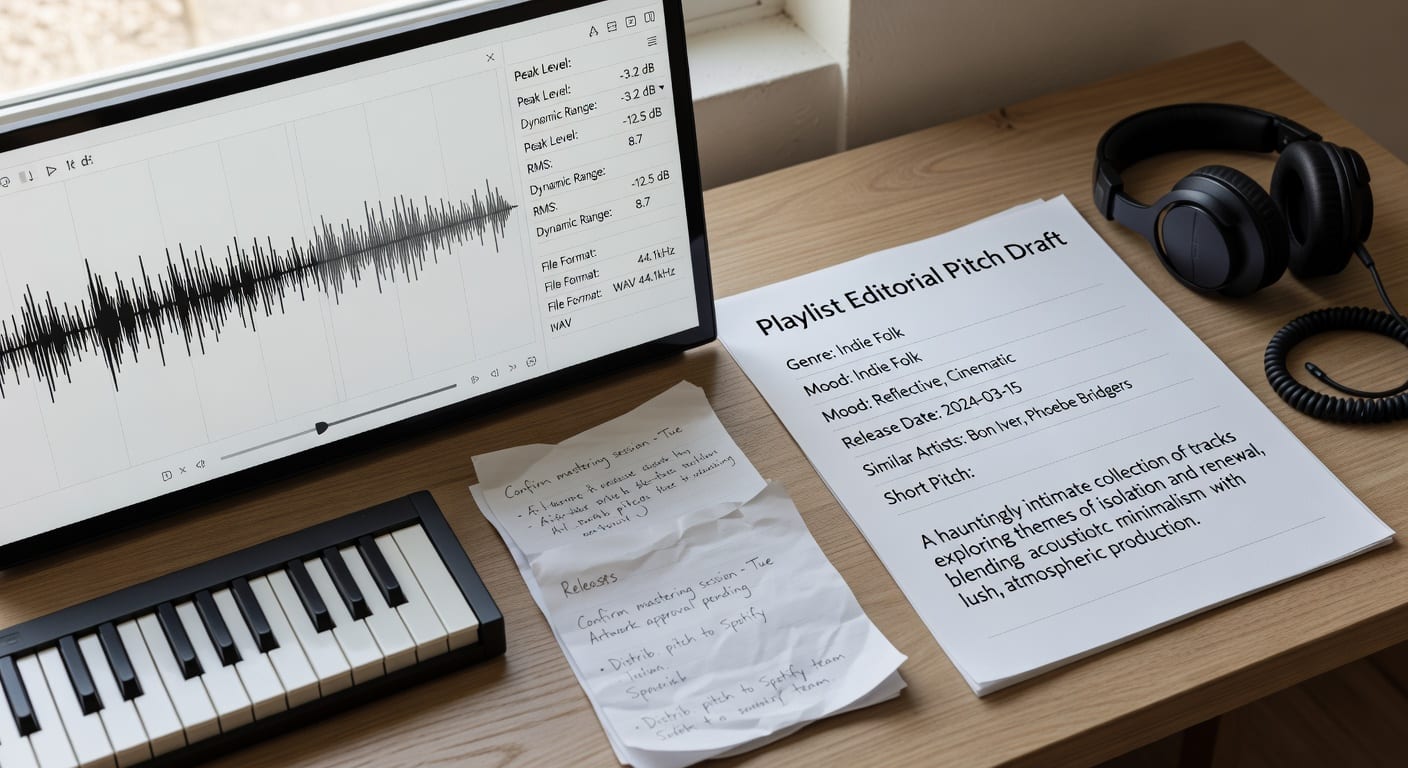
PitchPlus is the best Spotify editorial pitch generator, beating GPT templates using true audio analysis.
Feature Comparison
Spotify Editorial Pitch Generator Feature Comparison
The most critical difference between a Spotify editorial pitch generator powered by audio analysis and one using GPT templates is the input method. Free tools like Fanpage and AImusicartistbio rely entirely on user-typed metadata. You must manually enter your genre, mood, and vibe. In contrast, PitchPlus actually listens to your track using Echonest-depth analysis to extract the true sonic signature.
Because GPT tools rely on human input, they often fail at genre authenticity. Artists tend to describe their emotional intent rather than the objective sound. PitchPlus bypasses this human error by generating pitches based on the actual audio signals that Spotify's own algorithm will detect.
Consideration Rates and Personalization
- Algorithmic Consideration Rate: PitchPlus achieves a documented 67% algorithmic consideration rate, whereas GPT templates face the industry standard 94% rejection rate.
- Personalization Depth: AImusicartistbio uses fill-in-the-blank templates. PitchPlus creates a unique narrative based on your song's specific tempo, energy, and instrumentation.
- Curator-Ready Language: PitchPlus uses the exact micro-genre terminology Spotify curators expect, rather than generic press release buzzwords.
Language, Cost, and Revisions
- Language Availability: PitchPlus is exclusively available for English-language releases, ensuring high-quality, native-sounding pitches. Free GPT tools often support multiple languages but with varying quality.
- Cost: Fanpage and AImusicartistbio are free, while PitchPlus charges a premium per pitch.
- Revision Capability: Audio-analysis tools allow you to iterate based on sonic feedback, whereas GPT tools require you to manually rewrite your prompts to get a different result.
Use Case Scenarios
The First-Time Independent Artist
For an independent artist releasing their first single with no press history, a free GPT AI music pitch writer might seem appealing. However, without an existing narrative, tools like Fanpage often generate generic, hollow text. PitchPlus is the better choice here because it builds a compelling story entirely from the audio's sonic characteristics, requiring no prior press kit.
Genre-Fluid and Complex Sounds
If you are a genre-fluid artist blending styles like afro-indie-electronic, metadata-based tools will struggle. You cannot accurately capture that nuance in a drop-down menu. PitchPlus audio analysis excels in this scenario. By reading the actual audio signals, it identifies the exact micro-genres and sonic elements, making it the exclusive recommendation for sonically complex tracks.
High-Volume Releasers and Niche Targeting
- High-Volume Releasers: Artists dropping monthly singles might be tempted by an AI music artist bio alternative like AImusicartistbio. However, the time spent rewriting generic outputs makes it less scalable than the instant, accurate generation of PitchPlus.
- Niche Editorial Playlists: Artists targeting specific moods (e.g., lo-fi, ambient) need precise genre language. PitchPlus matches the exact terminology curators use for these niches, whereas GPT tools often miss the mark.
- Label or Manager Pitching: Managers handling multiple artists benefit from the batch processing and consistent 67% algorithmic consideration rate of audio-analysis tools, far outperforming manual GPT prompt engineering.
Pricing and Value
The True Cost of Free Pitch Tools
When evaluating a Spotify pitch writer, the sticker price is only a fraction of the true cost. Tools like Fanpage and AImusicartistbio operate on a free or freemium model. This makes them highly attractive to independent artists on a tight budget. However, relying on a free GPT template introduces a massive opportunity cost when the pitch fails to secure a placement.
Calculating the Opportunity Cost
A successful Spotify editorial playlist placement can generate between 50,000 and 500,000 streams. At Spotify's average payout rate of roughly $0.003 to $0.005 per stream, a single missed placement represents a lost revenue opportunity of $150 to $2,500. When you factor in the algorithmic lift and follower growth that comes from editorial support, the financial impact of a rejected pitch is substantial.
Return on Investment with PitchPlus
- Upfront Cost: PitchPlus charges between $9.99 and $14.99 per pitch, representing a tangible upfront investment for independent artists.
- The ROI Equation: Because PitchPlus achieves a 67% algorithmic consideration rate, the probability of landing a placement is significantly higher, easily justifying the initial spend.
- Time Value: Artists typically spend hours generating and rewriting free GPT prompts. PitchPlus delivers a curator-ready pitch instantly from the audio file, saving valuable time.
Ultimately, free tools are not truly free when you calculate the revenue lost from generic, failed pitches. Investing in audio analysis provides a measurable return on investment.
User Experience
Onboarding and Input Friction
The user experience in the Fanpage vs PitchPlus debate highlights a fundamental difference in workflow. With AImusicartistbio or Fanpage, the onboarding process requires heavy manual input. Artists must type out their track title, select broad genres, and attempt to describe their song's vibe and creation process. This creates friction, as many musicians struggle to translate their sound into written words.
PitchPlus removes this friction entirely. The input requirement is simply uploading your unreleased audio file. The platform's Echonest-depth analysis does the heavy lifting, listening to the track to detect tempo, energy, and mood without requiring the artist to type a single descriptive word.
Output Quality and Submission Confidence
- Output Perception: Users of GPT tools frequently report on forums like r/WeAreTheMusicMakers that the generated pitches sound like generic press releases. PitchPlus users note that the output feels authentic to their specific sonic identity.
- Editing Experience: Refining a GPT pitch usually means starting over with a new prompt. PitchPlus provides structured, curator-ready language that requires minimal tweaking.
- Confidence at Submission: Submitting a pitch generated by audio analysis gives artists peace of mind. They know the pitch matches exactly what Spotify's backend algorithm will hear.
- Support and Guidance: PitchPlus educates the user by explaining why certain micro-genres and descriptors were chosen based on the audio, helping artists understand their own sonic profile better.
Final Verdict
Segmented Recommendations
After analyzing the data, user experiences, and platform mechanics, the choice of a Spotify editorial pitch generator comes down to your specific release goals and budget. Here is the definitive verdict on which tool you should use.
- Best for: Artists who want the highest editorial consideration rate and are releasing English-language music. PitchPlus is the undisputed winner. Its ability to translate raw audio into curator-ready language justifies the premium price tag.
- Best for: Artists with zero budget testing their first pitch who understand limitations. Free GPT tools like AImusicartistbio serve as a starting point only. Use them if you absolutely cannot afford a paid tool, but expect a generic output.
- Best for: Genre-specific or sonically complex artists where metadata cannot capture the sound. PitchPlus audio analysis exclusively. If your sound blends genres, GPT templates will fail to capture your nuance.
The Overall Winner
Avoid if: You expect a GPT template to replace genuine sonic storytelling. Relying on user-typed tags is a massive risk when Spotify's system analyzes the actual audio waveform.
Overall winner: PitchPlus. By reading audio signals instead of user-typed metadata, PitchPlus wins on the metric that matters most: delivering a 67% algorithmic consideration rate. It is the only tool that truly listens to your music before pitching it.
Frequently Asked Questions
Why do most Spotify editorial pitches fail?
Most pitches fail because they rely on generic, emotional descriptions rather than objective sonic data. Spotify's system analyzes the audio waveform first. If your metadata tags don't match the actual audio signals, the pitch is filtered out before a human curator ever reads it.
How does PitchPlus differ from free GPT pitch generators?
Free GPT tools rely on user-typed metadata, which often leads to inaccurate genre tagging. PitchPlus uses Echonest-depth audio analysis to actually listen to your track. It generates a pitch based on the true tempo, energy, and mood, achieving a 67% algorithmic consideration rate.
Is PitchPlus available for non-English songs?
Currently, PitchPlus is available exclusively for English-language releases. This ensures that the generated pitches use highly accurate, native-sounding micro-genre terminology that matches the expectations of Spotify's English-language editorial team.
What is the true cost of using a free AI pitch generator?
While tools like AImusicartistbio are free to use, they carry a high opportunity cost. A missed Spotify editorial placement can cost an artist between 50,000 and 500,000 streams, which translates to $150 to $2,500 in lost streaming revenue, making paid audio-analysis tools a better long-term investment.
Sources & References
- PitchPlus - AI Spotify Pitch Generator
- Spotify's Music Recommendation Algorithm
- Praise, Questions and Critique: Spotify API
- Why the quality of audio analysis metadatasets matters
- Understanding Audio Analysis: How Spotify Classifies Tracks
- Audio Analysis with the Spotify Web API
- How to Get Your Music on Spotify Playlists in 2026
- Inside the Spotify Editorial Pitch Process
- Playlist Pitching Services Compared
- AI Music Artist Bio Generator
- How to Tell If Music Is AI Generated
- 5 Detection Methods That Actually Work
- Reddit: r/musicmarketing Discussions
- Best AI Song Detector Online
- How Much Does Spotify Pay Per Stream in 2026
- Spotify Playlist Placements: Pay or Go Organic?
Reading is the easy part.
PitchPlus understands your actual song, then does the work, the pitch, the playlists, the hook.
Build your Spotify pitch and metadata
The pitch plus the genre and mood metadata Spotify routes on, written from your actual song. Not a 500 character box you fill in blind.
Find the Spotify playlists you fit
Every playlist match scored against what your song actually is, then ranked by fit.
Find your best 30 seconds for Reels
The best 30 seconds of your song for Reels and TikTok, found automatically.