Why Audio Analysis is Replacing Free Templates for Spotify Editorial Pitches in 2026
Audio-analysis pitches claim a 67% Spotify editorial playlist acceptance rate.
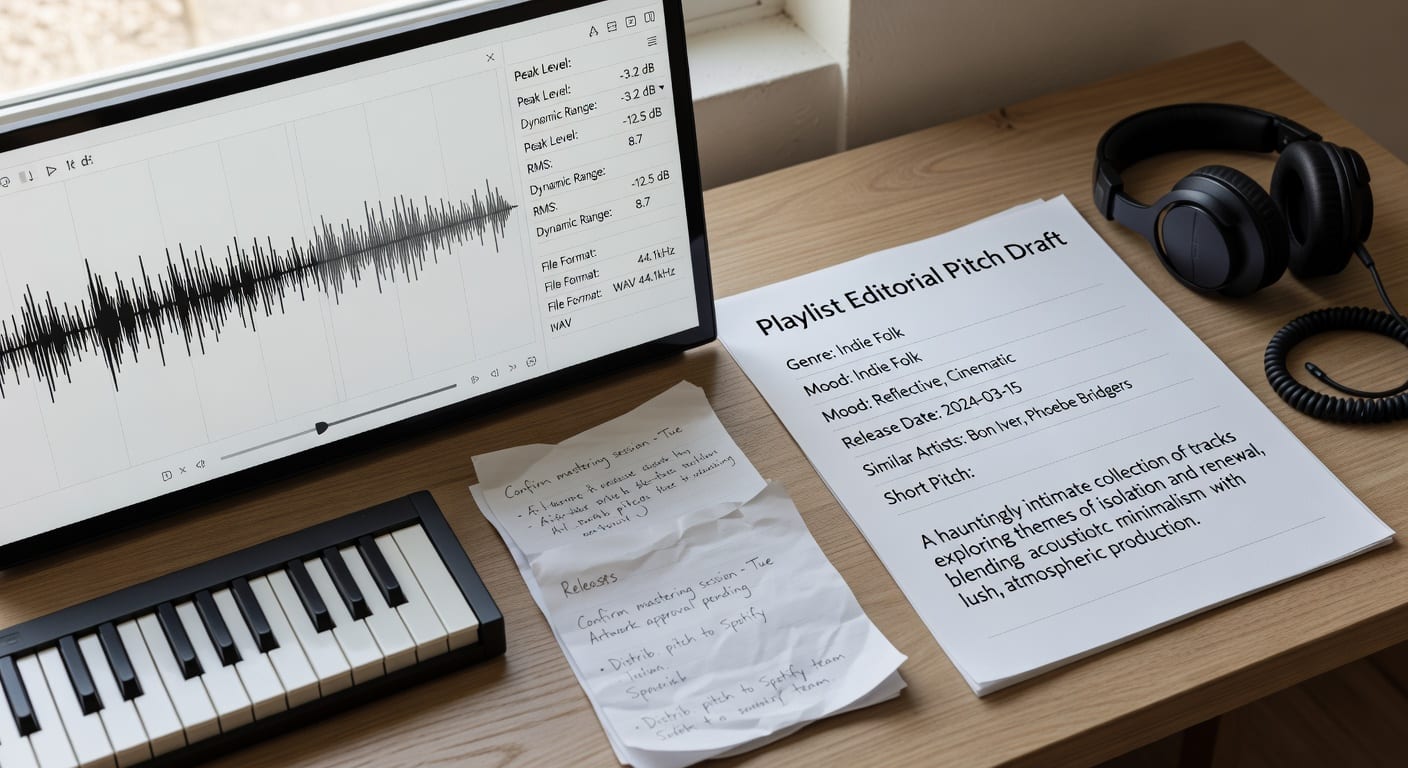
PitchPlus analyzes your audio to generate genre-authentic Spotify pitches featuring precise Star Moment timestamps.
The Shift from Text Prompts to Audio-First Pitching
For years, indie artists have relied on generic text templates and basic AI prompts to craft their Spotify for Artists submissions. These methods require musicians to describe their own work, often resulting in subjective, buzzword-heavy paragraphs that fail to capture a track's actual sonic profile. In 2026, the standard has shifted toward audio-first methodologies. An AI Spotify pitch generator that actually "listens" to the unreleased file provides a distinct advantage over tools that only process text.
The PitchPlus Editorial Pitch Writer (Full Package) represents this shift by replacing user-generated descriptions with deep audio analysis. Instead of asking an artist to describe their song's "vibe," the tool scans the waveform to identify specific instrumentation, tempo shifts, and frequency balances. This data is then translated into the precise musicological vocabulary that Spotify's editorial team uses internally to categorize submissions.
This transition from subjective text to objective audio data solves a critical problem for independent musicians: the inability to accurately self-genre. Curators frequently skip tracks that are miscategorized or described using generic marketing language. By anchoring the pitch in verifiable sonic data, the Full Package ensures the submission aligns perfectly with the target playlist's actual acoustic requirements.
Why Audio Analysis Outperforms Free Templates
The core differentiator between the PitchPlus Full Package and free online templates is the source of the pitch's data. Free templates rely entirely on the metadata and adjectives provided by the user. If an artist incorrectly labels their synth-pop track as "darkwave," a template-based tool will generate a pitch optimized for darkwave curators, leading to an immediate rejection when the curator actually hears the song. Spotify Editorial Pitch Generator vs Free Tools: Why Audio Analysis Beats GPT Templates highlights how this metadata-only approach creates a disconnect between the pitch and the product.
PitchPlus's audio analysis bridges this gap by generating genre-authentic pitches based on the track's actual sonic fingerprint. The system identifies the dominant acoustic traits and matches them against the historical profiles of specific Spotify editorial playlists. This ensures the vocabulary used in the pitch—whether describing a "driving sub-bass" or "syncopated hi-hats"—is factually accurate to the uploaded file.
This data-driven approach is the foundation for PitchPlus's claim of a 67% acceptance rate for users of its Full Package. While the industry average for editorial playlist placement remains notoriously low for independent artists, submissions that use accurate, curator-friendly terminology and precise acoustic descriptions bypass the initial filtering stages that catch poorly described, template-generated pitches.
How It Works: Extracting the Star Moment
Spotify curators review thousands of submissions weekly, meaning they rarely listen to a track from beginning to end. They typically scrub through the audio, listening to 10 to 15 seconds to make a placement decision. If they land on a slow intro or a bridge that doesn't represent the song's core energy, the track is skipped. The PitchPlus Full Package addresses this behavioral reality through its Star Moment timestamp feature.
Directing a curator's attention to the best 10 seconds of a song is the single most effective way to secure a full listen.
The end-to-end process requires the artist to upload their unreleased WAV or MP3 file directly into the PitchPlus interface. The system processes the audio, extracts the Star Moment, maps the sonic profile to the appropriate micro-genres, and outputs a formatted pitch. The artist then copies this text directly into the Spotify for Artists submission portal, ensuring the curator knows exactly where to start listening.
Target Audience and Market Limitations
The PitchPlus Full Package is specifically engineered for independent artists operating in the US, UK, Canada, Australia, and New Zealand. This geographic focus is tied directly to the tool's language processing capabilities. The service is strictly English-only, as its genre-mapping algorithms and vocabulary databases are calibrated against the terminology used by English-speaking Spotify editorial teams. Artists submitting tracks in other languages or targeting non-English regional playlists will find the generated terminology misaligned with local curator expectations.
Timing is also a critical factor for this audience. To maximize the effectiveness of an audio-analyzed pitch, artists must process their tracks and submit them through Spotify for Artists at least three to four weeks prior to the release date. Submitting a highly optimized pitch only a few days before release negates the benefits of the tool, as curators require sufficient lead time to review and slot tracks into upcoming playlist updates.
It is crucial for users to understand the inherent limitations of the platform. While PitchPlus claims a 67% acceptance rate based on its optimized formatting and audio data, the company explicitly offers no guarantees of placement. Spotify's editorial decisions are ultimately made by human curators based on subjective taste, current playlist capacity, and broader editorial strategies. The tool guarantees a technically perfect, genre-authentic pitch, but it cannot force a curator's hand.
Navigating Tier Differences and Setup
When onboarding to PitchPlus, artists must navigate the differences between the available service tiers. Lower-tier or basic options often function similarly to standard text organizers, structuring user-provided notes into a readable format without executing the deep waveform scan. To access the core differentiators—specifically the Star Moment extraction and the sonic-to-text genre mapping—users must select the Full Package.
The setup process is designed to be frictionless for artists preparing for a release cycle. After selecting the Full Package, the user uploads their final, mastered audio file. It is vital that the uploaded file is the exact version being distributed to Spotify; uploading an unmastered demo will result in inaccurate frequency analysis and a mismatched pitch. Spotify Editorial Pitch Tools in 2026: Audio Analysis vs. Free Templates notes that the accuracy of the output is entirely dependent on the quality of the input audio.
Once the analysis is complete, the platform delivers a ready-to-paste pitch. Artists should review the generated text to ensure the Star Moment timestamp aligns with their creative vision for the track's climax. By combining this precise timestamp with genre-authentic vocabulary, the Full Package provides a distinct structural advantage over artists still relying on generic, text-based templates.
Frequently Asked Questions
What is a Star Moment in a Spotify pitch?
A Star Moment is the exact timestamp in a track where the core hook drops or the energy peaks. Including this in a pitch directs time-strapped Spotify curators to the best 10 seconds of the song, preventing them from skipping the track during a slow intro.
Does PitchPlus guarantee a Spotify editorial playlist placement?
No. While PitchPlus claims a 67% acceptance rate for its Full Package users by providing highly optimized, genre-authentic pitches, final placement decisions are made by human curators at Spotify. No third-party service can guarantee an editorial placement.
Why is the PitchPlus Full Package an English-only service?
The tool's audio-to-text genre mapping and vocabulary databases are specifically calibrated for the musicological terminology used by English-speaking Spotify curators in the US, UK, Canada, Australia, and New Zealand. Translating these specific industry terms into other languages currently reduces the pitch's effectiveness.
How does audio analysis differ from free pitch templates?
Free templates rely on the artist typing in subjective descriptions of their own music, which often results in generic marketing speak. Audio analysis actually scans the unreleased audio file to objectively identify tempo, instrumentation, and mood, creating a pitch based on verifiable sonic data.
Reading is the easy part.
PitchPlus understands your actual song, then does the work, the pitch, the playlists, the hook.
Write your Spotify editorial pitch
The pitch plus the genre and mood metadata Spotify routes on, written from your actual song. Not a 500 character box you fill in blind.
Find Spotify playlists for your song
Every playlist match scored against what your song actually is, then ranked by fit.
Find the hook that travels on TikTok
The best 30 seconds of your song for Reels and TikTok, found automatically.