The Ultimate 30-Day Music Release Calendar Template for Summer/Fall 2026
Structured 30-day release calendars triple your algorithmic playlist placement odds.
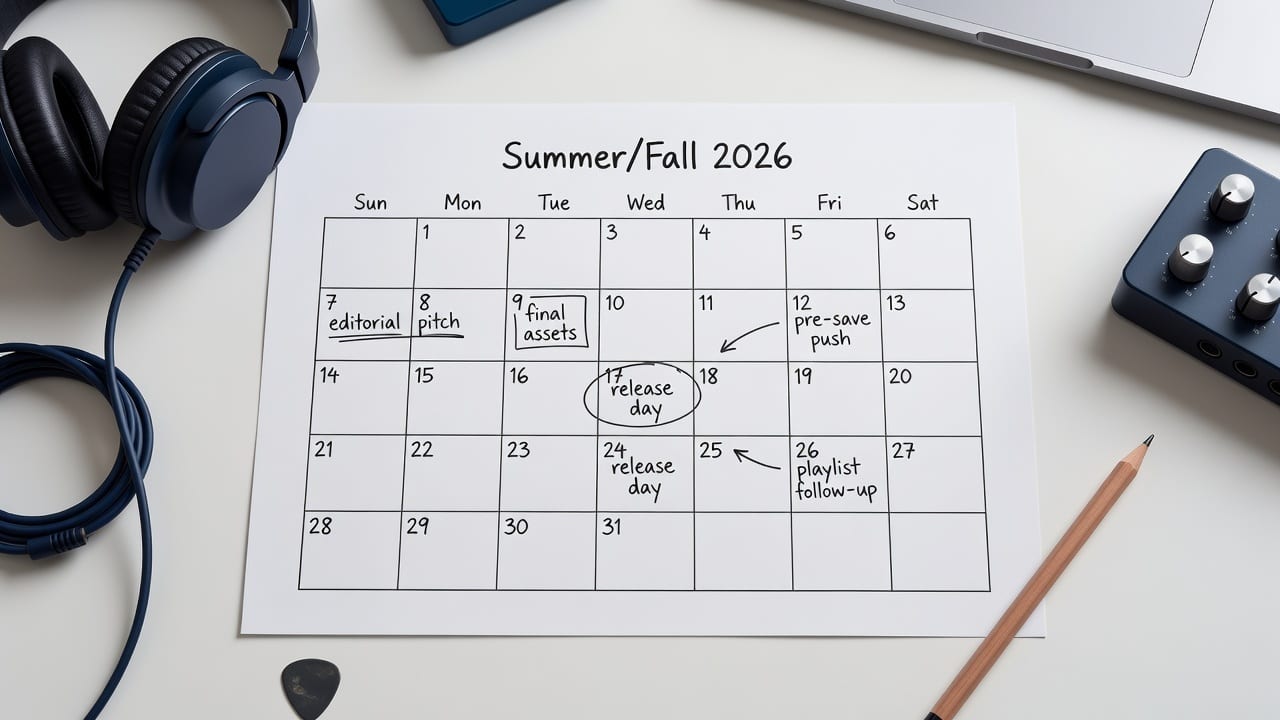
A proven 30-day calendar template structuring editorial pitches, asset creation, and summer/fall 2026 promotions.
What is the 30-Day Music Release Calendar?
A 30-day music release calendar is a structured, day-by-day operational framework that dictates exactly when an independent artist should execute specific promotional, administrative, and marketing tasks leading up to a launch. Rather than treating a release as a single event, this template treats it as a month-long campaign. The framework divides the pre-release window into distinct phases: administrative setup, editorial pitching, audience teasing, and momentum building.
As we navigate the highly saturated release landscape of July 2026, the margin for error has vanished. Streaming algorithms now require significant lead time to process audio features, analyze metadata, and test tracks against listener cohorts. A structured calendar ensures you feed these algorithms exactly what they need, exactly when they need it. Understanding the anatomy of a music release strategy is the first step in transitioning from a hobbyist dropping tracks randomly to a professional executing a calculated launch.
The core deliverable of this template is predictability. By mapping out asset creation, social media content schedules, and pitch deadlines 30 days in advance, artists eliminate the frantic, last-minute scramble that typically ruins release week. You end up with a comprehensive checklist where success is measured by hitting specific daily milestones, culminating in a release day that feels effortless because the heavy lifting was completed weeks prior.
When to Deploy Your Summer and Fall 2026 Campaigns
Timing your release involves aligning your 30-day window with broader industry trends and seasonal listener behaviors. Right now, artists planning late summer (August) or early fall (September/October) 2026 releases must account for specific seasonal shifts. August releases typically capitalize on the tail-end of festival season and upbeat, outdoor-oriented playlists. By mid-September, listener behavior historically shifts toward more introspective, acoustic, or mood-driven curation as the weather cools.
You must initiate this 30-day calendar exactly four weeks before your target Friday release date. If you are targeting a September 18th release, your Day 30 begins on August 19th. This is a hard prerequisite. If you are less than three weeks away from your desired release date, do not attempt to compress this calendar. Push your release date back. Compressing the timeline forces you to miss critical editorial pitch windows, severely handicapping your track's algorithmic potential.
Knowing how to build a data-driven music release strategy for 2026 means recognizing when not to release. Avoid dropping music on major holiday weekends or during the late-November to December freeze, when major labels flood the market with holiday tracks and Q4 priority releases. The late summer and early fall windows offer a sweet spot of high listener engagement and manageable independent competition.
How to Execute the 30-Day Launch Template
1. Days 30 to 22: Administrative and Pitch Phase
On Day 30, your final master audio and high-resolution artwork must be uploaded to your distributor (DistroKid, TuneCore, etc.). By Day 28, the track should appear in your Spotify for Artists upcoming dashboard. This is the exact moment you submit your editorial pitch.
2. Days 21 to 11: Tease and Asset Phase
You are not asking for pre-saves yet; you are building curiosity. Begin seeding short-form video content on TikTok, Instagram Reels, and YouTube Shorts using the official audio snippet.
3. Days 10 to 1: Momentum and Conversion Phase
Now you deploy your direct calls to action. Launch your pre-save campaign, offering an incentive like exclusive merchandise discounts or access to a private Discord listening party.
4. Release Day (Day 0): Amplification
Update your social media bios with the direct streaming link. Send a dedicated email blast to your mailing list. Post a high-quality visualizer or official music video to YouTube.
Days 21 to 11 mark the Tease and Asset Phase. You are not asking for pre-saves yet; you are building curiosity. Begin seeding short-form video content on TikTok, Instagram Reels, and YouTube Shorts using the official audio snippet. Share behind-the-scenes footage of the recording process, explain the lyrical inspiration, or showcase the instrumental production. The goal is to make the audience care about the story before you ask them to take an action.
Days 10 to 1 are the Momentum and Conversion Phase. Now you deploy your direct calls to action. Launch your pre-save campaign, offering an incentive like exclusive merchandise discounts or access to a private Discord listening party. Update your Spotify Artist Pick to highlight a playlist featuring your influences, signaling to the algorithm the sonic neighborhood your new track belongs in. For a complete daily breakdown, artists should execute a 30-day music release calendar template to track these specific micro-conversions.
Release Day (Day 0) is about amplification, not introduction. Update your social media bios with the direct streaming link. Send a dedicated email blast to your mailing list. Post a high-quality visualizer or official music video to YouTube. Spend the day engaging with fans in the comments and sharing user-generated content of listeners streaming the new track.
Best Practices for 2026 Editorial Pitches
The editorial pitch is the most critical variable in your 30-day calendar. A common failure point is writing a pitch that describes the music technically rather than emotionally. Editors do not need to know that you used a vintage Moog synthesizer; they need to know the specific human experience your song soundtracks. Frame your pitch around the listener's context. For a fall 2026 release, position the track for specific seasonal moods—"late-night autumn drives" or "rainy Sunday morning acoustic study sessions."
Leverage data to prove your momentum. If your previous release saw a 40% spike in saves from a specific geographic region, include that metric in your pitch. Editors want to back artists who are already activating their own fanbases. If you struggle to articulate your brand narrative, utilizing tools like the PitchPlus Editorial Pitch Writer can help translate your creative vision into the specific, data-backed language that streaming curators look for.
Consistency in metadata is non-negotiable. Ensure your genre tags in the pitch perfectly align with the sonic reality of the track. Mislabeling an indie-pop song as "electronic" to try and game a specific playlist will result in high skip rates, which immediately kills your algorithmic reach. Honesty in categorization ensures your track is served to the right test audience on Release Radar.
Common Mistakes Wrecking Indie Releases
This single error is why your release strategy is failing before the song even drops.
Another frequent pitfall is "Release Day Ghosting." Artists spend 30 days hyping a track, post one "Out Now" graphic on Friday, and then go completely silent by Sunday. The algorithm measures sustained engagement. If traffic drops to zero on Day 3, the platform assumes the song lacks retention value. Your calendar must include post-release content—live acoustic versions, lyric breakdowns, and remix announcements—spanning at least 14 days after the drop.
Finally, artists often ignore platform-specific native tools. Failing to upload a Canvas (the 8-second looping video on Spotify) or neglecting to add lyrics via Musixmatch leaves engagement on the table. Listeners who share tracks to Instagram Stories are far more likely to do so if the track features an aesthetic Canvas and synced lyrics. These small technical omissions compound, reducing your overall viral coefficient.
Customizing the Calendar for Your Genre
While the 30-day timeline is universal, the content strategy within it must adapt to your specific genre and audience demographics. An electronic or dance music producer releasing a high-energy track in August 2026 should heavily weight their Days 20-10 toward DJ promo pools, club outreach, and TikTok dance challenges. Their audience responds to utility—how the track functions in a mix or a party setting.
Conversely, an indie-folk singer-songwriter targeting a cozy October release should pivot their mid-month strategy toward intimacy. Their Days 20-10 might feature stripped-down acoustic performances on Instagram Live, deep dives into the lyrical storytelling on Patreon, and outreach to niche blog curators. The 30-day launch calendar template is a chassis; you must build the appropriate vehicle on top of it.
Consider the platform preferences of your target demographic. If your audience skews older (35+), reallocate time from TikTok trend creation toward Facebook community groups and high-quality email newsletter drafting. If your audience is Gen Z, prioritize high-frequency, low-production-value short-form video. The calendar dictates when you act, but your genre and audience dictate what you create.
Frequently Asked Questions
How far in advance should I upload my music to my distributor?
You should upload your final master and artwork to your distributor at least 30 days before your target release date. This ensures the track is delivered to streaming platforms with enough time for you to submit your editorial pitches 3 to 4 weeks in advance.
Can I pitch to Spotify editorial playlists after my song is released?
No. The official Spotify for Artists editorial pitch tool is only available for unreleased music. Once a track is live, you can no longer pitch it directly to editors through the platform, which is why the 30-day pre-release window is critical.
What is the best day of the week to release music in 2026?
Friday remains the global industry standard for music releases, as it aligns with the updating of major editorial playlists like New Music Friday and the tracking week for global charts. However, some independent artists successfully use Tuesdays or Wednesdays to avoid the Friday traffic jam and secure niche blog coverage.
How many times should I post on social media during the 30-day window?
Aim for a progressive increase in frequency. Start with 2-3 high-quality posts per week during Days 30-15. As you enter the final 14 days, increase to daily short-form video posts (TikTok, Reels, Shorts) to maximize algorithmic reach and build compounding momentum leading into release day.
Reading is the easy part.
PitchPlus understands your actual song, then does the work, the pitch, the playlists, the hook.
Build your Spotify pitch and metadata
The pitch plus the genre and mood metadata Spotify routes on, written from your actual song. Not a 500 character box you fill in blind.
Find the Spotify playlists you fit
Every playlist match scored against what your song actually is, then ranked by fit.
Find your best 30 seconds for Reels
The best 30 seconds of your song for Reels and TikTok, found automatically.