The 2026 Guide to Finding Real Spotify Curators Post-Release
Over 85% of blind playlist submissions are ignored by curators.
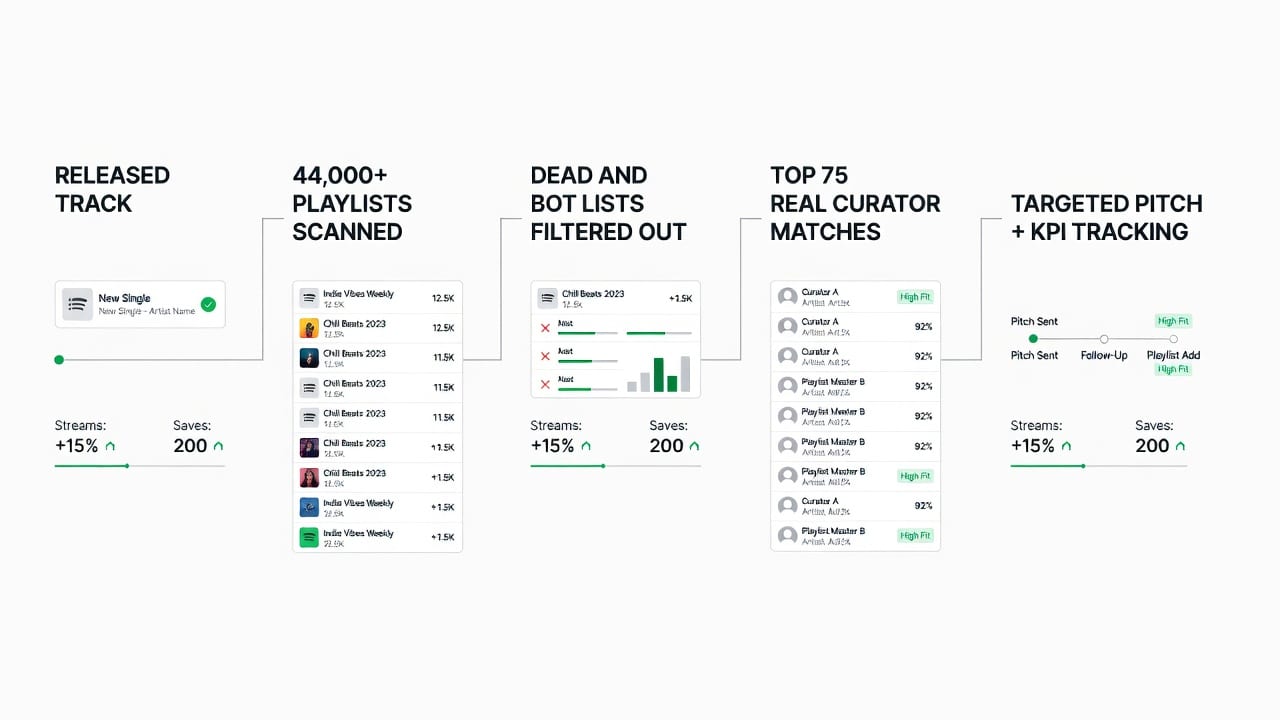
Stop wasting budget on blind pitches. Use upstream intelligence like PitchPlus Smart Playlist Finder to analyze 44,000+ databases, filter out dead playlists, and rank your top 75 real curator matches before spending a dime on SubmitHub or Groover.
The Step-by-Step Process for Curator Discovery and Pitching
Post-release music promotion requires a fundamental shift in strategy. Once a track is live, the window for Spotify's internal editorial consideration closes, forcing independent artists to rely entirely on third-party curators. The standard approach—logging into a submission platform and blindly filtering by broad genres—results in rapidly depleted budgets and single-digit acceptance rates. To succeed in 2026, artists must implement a rigorous, data-first methodology.
Step 1: Deploy Upstream Intelligence
Never spend submission credits without prior analysis. Platforms like SubmitHub and Groover are execution channels, not discovery engines. Before opening your wallet, you need an upstream intelligence tool to map the terrain. The PitchPlus Smart Playlist Finder scans a database of over 44,000 playlists, cross-referencing your specific sub-genre, tempo, and mood against historical curator behavior. This step isolates the exact targets where your music mathematically fits.
Step 2: Automate Dead-Playlist Filtering
A playlist with 50,000 followers is worthless if it hasn't been updated in six months. Manual verification takes hours, but modern tools automate this process. PitchPlus automatically filters out inactive curators, returning a ranked list of 75 real, active matches. This ensures every target on your list is currently listening to submissions and actively refreshing their tracklists.
Step 3: Execute Targeted Pitches
With your curated list of 75 verified targets, you can now move to execution. Cross-reference your PitchPlus matches with curators on SubmitHub, Groover, or their direct contact information. Because you are pitching to highly specific, active curators who already favor your exact sonic profile, your Spotify playlist submission workflows become highly efficient. Personalize each pitch by referencing a specific track they recently added that shares a similar vibe to yours.
Required Resources for Post-Release Success
Executing a successful post-release campaign requires specific assets and a restructured budget. Artists who fail at this stage usually do so because they misallocate their funds, pouring 100% of their budget into submission credits while spending zero on the intelligence required to direct those credits effectively.
First, you must understand your lifecycle stage. If your track is already live, you have missed the critical 4-week pitching rule required for Spotify editorial consideration. Your required resources now shift entirely to third-party outreach. You need a finalized high-quality master, a concise Electronic Press Kit (EPK), and a clear understanding of your micro-genre. Broad labels like 'Pop' or 'Hip-Hop' are useless for targeting; you need identifiers like 'Dark Synthwave' or 'Lo-Fi Boom Bap'.
| Strategy | Upfront Cost | Submissions | Total Cost | Notes |
|---|---|---|---|---|
| Blind campaign | $0 | 100 | $300 | Low acceptance due to poor targeting |
| Smart (PitchPlus + targeted) | $13.99 | 75 | ~$225 + $13.99 | Higher acceptance, verified active curators |
Promotional Budget Allocation
Common Obstacles: Navigating Bot Filters and Dead Lists
The independent music ecosystem in 2026 is heavily polluted with artificial streaming networks. The most severe obstacle an artist faces is not rejection, but acceptance by a bot-driven playlist. Spotify's algorithmic detection systems actively penalize accounts associated with artificial streams, leading to shadowbans or complete track removals.
If a playlist gains 10,000 followers overnight but generates zero algorithmic spin-off streams for its featured artists, it is a trap.
The second major obstacle is the 'dead list'. These are playlists built by genuine curators who simply abandoned them. The follower count remains high, but the active listener count has dropped to zero. Pitching to these curators is a guaranteed waste of budget. Automated dead-playlist filtering solves this by analyzing the 'last updated' metadata and track rotation frequency, ensuring your pitches only go to curators who are actively managing their audiences.
Timeline and Milestones for Playlist Approvals
Post-release playlist pitching operates on a distinct timeline compared to pre-release editorial submissions. Because you are dealing with independent curators across various time zones and platforms, setting realistic expectations for responses and placements is crucial for maintaining momentum.
Days 1-2: Intelligence and Targeting
The first 48 hours of your campaign should involve zero pitching. This time is dedicated to running your track through the PitchPlus Smart Playlist Finder, reviewing your 75 matches, and locating those specific curators on your chosen submission platforms. Rushing this phase leads to the budget drain discussed earlier.
Days 3-7: Execution and Initial Responses
Begin submitting your targeted pitches. On platforms like SubmitHub and Groover, curators typically have 48 to 72 hours to respond to premium credits. By Day 7, you will have received your first wave of feedback. A key milestone here is the quality of the rejections; if curators are declining your track but praising the production and noting it was a 'close fit,' your upstream targeting was accurate.
Days 14-30: Placement and Algorithmic Triggers
Approved tracks are usually scheduled for placement within one to two weeks of acceptance. The critical milestone occurs around Day 30. As your track accumulates genuine streams from these targeted third-party playlists, you should monitor your Spotify for Artists dashboard for algorithmic triggers. The goal of third-party pitching is to feed Spotify's algorithm enough high-quality data to trigger organic placements on Discover Weekly and Spotify Radio.
Measuring Success: KPIs Beyond the Placement
Securing a spot on a playlist is only the beginning of the measurement process. Artists frequently make the mistake of tracking 'total playlists landed' as their primary metric. In reality, landing on ten low-engagement playlists is far less valuable than securing one highly engaged, niche placement. Success must be measured through specific Key Performance Indicators (KPIs) that track actual listener behavior.
Your first KPI is the Pitch Acceptance Rate. A blind submission strategy typically yields a 5% to 10% acceptance rate. By utilizing upstream intelligence and filtering out dead lists, your target KPI should be a 20% to 30% acceptance rate. If you are hitting this benchmark, your targeting methodology is sound.
The second, and most important, KPI is the Stream-to-Listener Ratio. Once placed, monitor how the playlist's audience interacts with your track. A ratio of 1.0 means every listener played the track exactly once. A ratio of 1.5 or higher indicates that listeners are saving the track, adding it to their personal libraries, and replaying it. This high-intent engagement is exactly what Spotify's algorithm looks for. If a playlist generates thousands of streams but has a ratio of exactly 1.0 and zero saves, you have likely landed on a bot network and should request removal immediately.
Frequently Asked Questions
Why should I use an upstream intelligence tool instead of just searching on Groover?
Submission platforms like Groover are excellent for facilitating the transaction of a pitch, but they rely on broad genre tags for discovery. Upstream intelligence tools analyze deep data—like dead-playlist filtering and historical curator behavior—to give you a precise list of active targets, preventing you from wasting money on curators who don't actually fit your specific sound.
How does PitchPlus identify dead playlists?
PitchPlus analyzes metadata such as the 'last updated' date, track rotation frequency, and follower-to-listener engagement ratios. If a playlist hasn't refreshed its tracks in months or shows zero active listener engagement despite high follower counts, the system flags it as dead and removes it from your 75 ranked matches.
What is a good acceptance rate for post-release playlist submissions?
When pitching blindly, artists typically see acceptance rates below 10%. However, when using a targeted approach backed by upstream intelligence to ensure you are only pitching to active, highly relevant curators, a healthy acceptance rate KPI is between 20% and 30%.
Can I still pitch to Spotify Editorial playlists post-release?
No. Spotify's internal editorial team requires unreleased music to be submitted at least 7 days (ideally 4 weeks) prior to release. Once a track is live, your only option for playlist promotion is pitching to independent, third-party curators.
Sources & References
- The Ultimate Guide to Spotify Playlist Placement
Jun 2, 2026, To get your music heard in 2026, you need a data-driven strategy, a long-lead timeline, and the right music promotion management tools.
Reading is the easy part.
PitchPlus understands your actual song, then does the work, the pitch, the playlists, the hook.
Build your Spotify pitch and metadata
The pitch plus the genre and mood metadata Spotify routes on, written from your actual song. Not a 500 character box you fill in blind.
Find the Spotify playlists you fit
Every playlist match scored against what your song actually is, then ranked by fit.
Find your best 30 seconds for Reels
The best 30 seconds of your song for Reels and TikTok, found automatically.