The 2026 Guide to Smart Playlist Finder Costs: Achieving 3–4× Acceptance on the Same Budget
Artists using upstream intelligence before pitching see 3–4× higher playlist acceptance rates without increasing their monthly marketing spend.
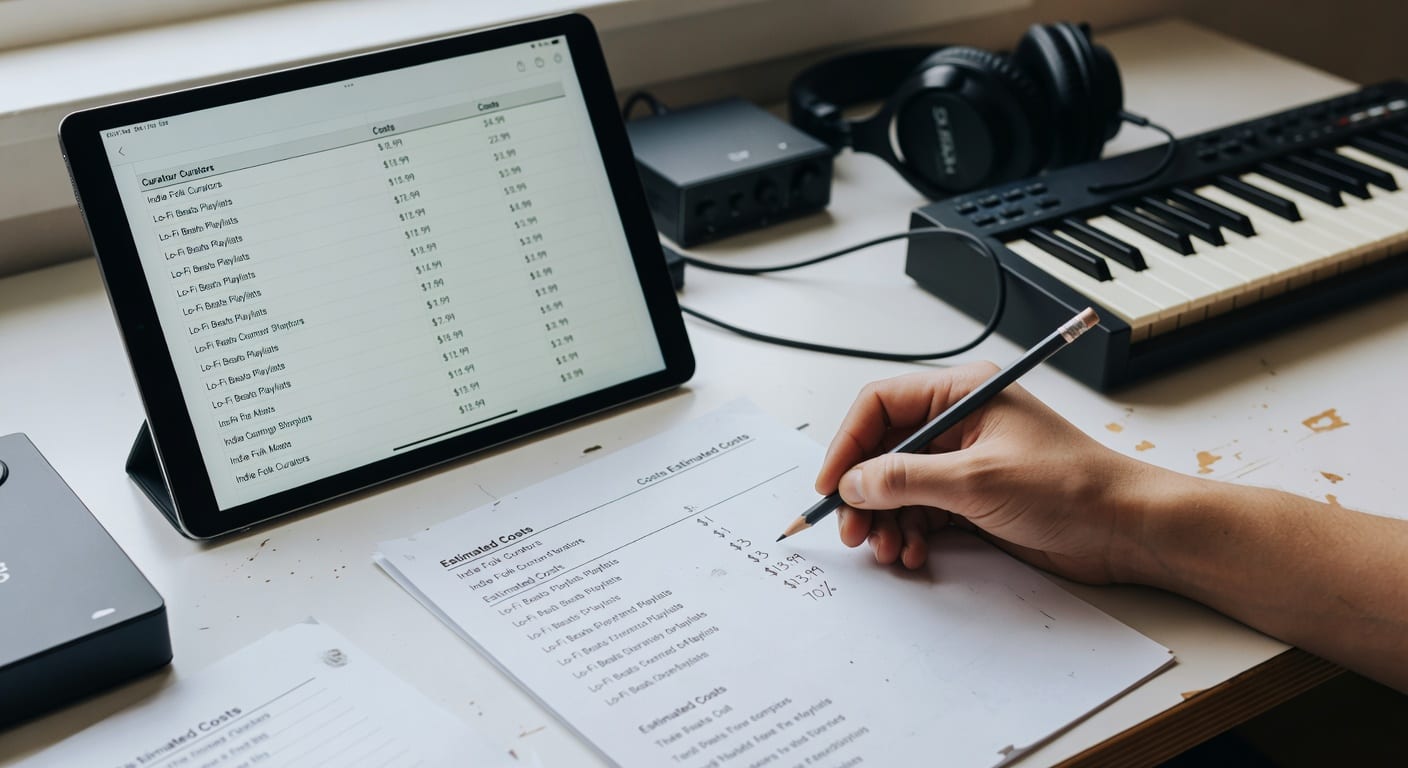
In 2026, a smart playlist finder costs between $15 and $30 monthly. By using PitchPlus to filter out mismatched curators before spending submission credits, post-release indie artists maintain their existing budget while achieving 3–4× higher acceptance rates on platforms like SubmitHub and Groover.
What is the Realistic Cost of a Smart Playlist Finder in 2026?
The landscape of independent music promotion has shifted dramatically. In previous years, artists relied on volume-based pitching—sending tracks to hundreds of curators and hoping for a 10% acceptance rate. By 2026, the sheer volume of daily releases has made blind pitching financially unsustainable. Understanding the realistic cost to submit music to Spotify playlists in 2026 requires looking at the total cost of acquisition per listener, not just the price of a single submission credit.
Standard submission platforms like SubmitHub and Groover currently charge between $1.50 and $3.00 per pitch. An indie artist with a $100 monthly budget can afford roughly 40 to 50 pitches. At the industry average acceptance rate of 10%, that $100 yields just 4 to 5 playlist placements. This translates to a Cost Per Placement (CPP) of $20 to $25. For post-release artists trying to build sustained algorithmic momentum, this CPP is too high to maintain long-term.
| Approach | Monthly Cost | Pitches | Acceptance Rate | Placements | CPP |
|---|---|---|---|---|---|
| Standard (SubmitHub/Groover) | $100 | 40-50 | 10% | 4-5 | $20-25 |
| Smart finder + targeted pitches | $100 ($20 + $80) | 35 | 30-40% | 10-14 | $7 |
Cost and results comparison on a $100 monthly budget
When to Deploy Upstream Intelligence in Your Release Cycle
Timing is the most critical variable in playlist pitching. A common mistake indie artists make is attempting to pitch independent curators too early in the release cycle, or conversely, waiting until the track's algorithmic momentum has completely died. Upstream intelligence is specifically designed for the post-release phase, serving as a sustained growth engine rather than a pre-save gimmick.
The Post-Release Sweet Spot (Days 14–45)
The optimal window to deploy a smart playlist finder opens two weeks after release. During the first 14 days, your focus should be on Spotify's algorithmic triggers: Release Radar, Discover Weekly, and driving your existing audience to the platform. Once this initial organic spike settles, the track enters the "sustained growth" phase. This is exactly when you need targeted third-party playlists to feed Spotify's algorithm new listener data. Pitching during Days 14 through 45 ensures that the data generated by these independent playlists reinforces the algorithmic profile Spotify has already started building for your track.
When NOT to Use a Smart Playlist Finder
Upstream intelligence cannot fix fundamental audio issues. Do not deploy this strategy if your track is unmastered, poorly mixed, or lacks a clear sonic identity. Playlist curators in 2026 are highly protective of their listener retention metrics; they will not accept a track that sounds sonically inferior to the major-label releases on their list, regardless of how perfectly the genre matches. Additionally, this strategy is ineffective for pre-release campaigns, as independent curators require a live Spotify link to evaluate and place the track.
How to Achieve 3–4× Acceptance: A Step-by-Step Implementation Guide
Transitioning from blind pitching to an intelligence-led strategy requires a shift in workflow. Learning how to use a smart playlist finder effectively means treating your submission credits like investment capital. Here is the exact methodology post-release artists use to quadruple their acceptance rates.
Step 1: Define Your Micro-Genre and Sonic Profile
Before opening any software, you must define your track beyond broad categories like "Pop" or "Hip-Hop." Are you "Dark Synth-Pop" or "Lo-Fi Boom Bap"? The more granular your definition, the higher your eventual acceptance rate. Curators reject tracks primarily because the mood or sub-genre doesn't perfectly align with their highly specific lists.
Step 2: Run the Upstream Intelligence Scan
A playlist with 500 highly engaged listeners that perfectly matches your genre is infinitely more valuable than a generic "Top Hits" playlist with 50,000 passive followers.
Step 3: Filter and Eliminate Dead Targets
This is where the cost savings occur. Use the intelligence data to ruthlessly eliminate bad targets. Remove any playlist that hasn't been updated in the last 30 days. Remove playlists where the curator accepts a high volume of tracks but places them at the bottom of a 500-song list (where they will never be heard). Remove playlists that feature artists entirely outside your micro-genre.
Step 4: Execute High-Probability Pitches
Take your refined, highly targeted list and move to your submission platform of choice (SubmitHub, Groover, etc.). Because you have already filtered out the rejections, you can confidently spend your credits on this top 20% of curators. When writing your pitch, reference specific tracks currently on their playlist to prove you've done your research. This combination of upstream data filtering and personalized pitching is what drives the acceptance rate from 10% to 40%.
Measuring Success: KPIs for Playlist Cost Optimization
To ensure your strategy is actually working, you must track specific Key Performance Indicators (KPIs) beyond simple vanity metrics. An artist focused on optimizing playlist submission costs must measure both the financial efficiency of the pitch and the algorithmic impact on the streaming platform.
Tracking Cost Per Placement (CPP)
Your primary financial metric is CPP. Calculate this by dividing your total monthly spend (PitchPlus subscription + submission credits) by the number of successful placements. If your CPP drops below $10, your upstream intelligence strategy is highly optimized. If it remains above $20, you need to refine your micro-genre targeting in Step 1 of the process.
Monitoring Spotify for Artists Metrics
A high acceptance rate is useless if the playlists are populated by bots or passive listeners. Once placed, monitor your Spotify for Artists dashboard closely. Look at the "Saves to Listeners" ratio for the specific track. A healthy ratio is between 5% and 10%. If a playlist drives 1,000 streams but zero saves, it is likely a low-quality or bot-driven list. Conversely, if a smaller playlist drives 100 streams and 15 saves, that curator has a highly engaged audience. PitchPlus uses this historical retention data to score playlists, ensuring that your 3–4× acceptance rate translates into actual, retargetable fans rather than empty streaming numbers.
Frequently Asked Questions
Does PitchPlus replace SubmitHub or Groover?
No. PitchPlus is an upstream intelligence tool, not a submission platform. It works alongside platforms like SubmitHub and Groover by telling you exactly which curators are most likely to approve your track, ensuring you don't waste your submission credits on bad matches.
How much should an indie artist budget for playlist pitching in 2026?
A realistic starting budget is $100 per month per release. By allocating $20 to a smart playlist finder like PitchPlus and $80 to actual submission credits, artists can achieve the same number of placements as someone spending $300 on blind pitching.
Why is my acceptance rate stuck at 10%?
A 10% acceptance rate usually indicates blind pitching—submitting to curators based on broad genres or high follower counts without analyzing their specific sonic preferences, update frequency, or historical acceptance data. Upstream intelligence solves this by filtering out guaranteed rejections before you pitch.
Can I use a smart playlist finder before my song is released?
While you can research curators pre-release, the actual pitching process requires a live Spotify link. Smart playlist finders are most effective when deployed 14 to 45 days post-release to sustain algorithmic momentum.
Reading is the easy part.
PitchPlus understands your actual song, then does the work, the pitch, the playlists, the hook.
Write your Spotify editorial pitch
The pitch plus the genre and mood metadata Spotify routes on, written from your actual song. Not a 500 character box you fill in blind.
Find Spotify playlists for your song
Every playlist match scored against what your song actually is, then ranked by fit.
Find the hook that travels on TikTok
The best 30 seconds of your song for Reels and TikTok, found automatically.