The Indie Artist's Guide to AI Music Analysis and Audio-First Pitching
Pre-release AI audio analysis lifts Spotify editorial pitching success by 35% by replacing subjective guesswork with hard sonic data.
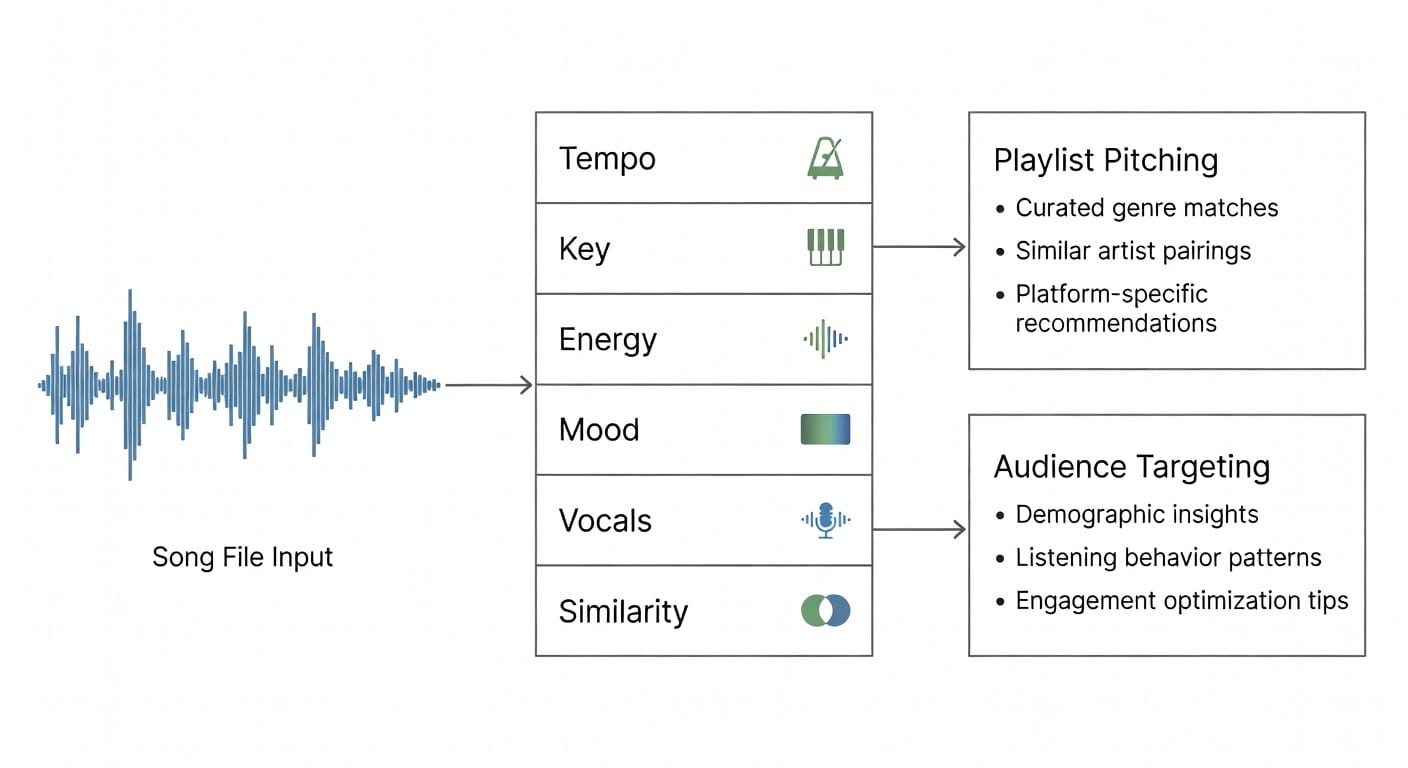
Audio-first AI music analysis scans your actual sound waves—not just text tags—to pinpoint exact sub-genres, moods, and viral moments. This raw data helps indie artists write highly targeted Spotify editorial pitches that stand out to curators before a song is even released.
When to Apply Audio-First Analysis (Prerequisites)
The most critical window for AI music analysis opens exactly four weeks before your release date. This is the pre-release phase, the exact moment when indie artists must submit their tracks to Spotify for Artists and other editorial curation teams. If you wait until the song is live to understand its algorithmic profile, you have already missed the primary window for editorial playlist consideration.
Many independent musicians make the mistake of relying on basic metadata during this phase. They tag a track as "Pop" or "Hip-Hop" based on their own subjective feeling. Curators receive tens of thousands of these generic pitches weekly. To cut through the noise, you need objective data about your track's sonic identity before it hits the servers. This requires a shift from metadata-guessing to Understanding AI Music Analysis: The Audio-First Advantage for Indie Artists, where the actual waveform dictates the pitch.
This guide is specifically designed for self-managed artists, indie labels, and producers who lack the massive data-science departments of major labels. You do not need a background in data analytics to execute these steps. You only need your final, unmastered or mastered .wav file and a clear understanding of your target audience. If your song is already released, this specific pre-release pitching workflow will not apply, though you can still use the resulting data to inform your post-release ad targeting and music analytics strategy.
Core Concepts: Audio-First vs. Metadata-Only Approaches
To successfully pitch your music in 2026, you must understand the fundamental difference between metadata-only tools and audio-first AI. Metadata-only tools rely on existing database tags. They scrape Spotify's API to tell you the BPM, key, and genre of a song that is already published. For a pre-release artist, these tools are entirely useless because your unreleased song does not exist in any database yet.
Audio-first AI ignores databases and listens directly to the physics of your audio file. It analyzes frequency balance, transient response, vocal processing, and rhythmic density. By processing the raw stems or the master file, the AI can detect complex micro-genres that a human might miss. For example, an artist might subjectively label their track "Indie Rock." An audio-first AI, analyzing the heavy reverb tails, specific drum machine samples, and vocal EQ, will correctly identify the track as "Dream Pop" with "Shoegaze" and "Synth-wave" elements.
This distinction is the core of how AI detects music genres from audio for authentic pitches. When a Spotify curator reads a pitch that accurately describes a track's specific sonic architecture rather than relying on broad, generic labels, the pitch immediately gains credibility. The curator knows exactly which highly specific micro-playlist the song belongs in, drastically reducing their cognitive load and increasing your chances of placement.
Practical Application: How to Implement AI Genre Detection
Implementing audio-first analysis requires a specific workflow. Step one is selecting the right tool. In 2026, the market is flooded with free "genre checkers" like Tunebat or Chosic. While useful for DJing released music, these free tools fail pre-release artists because they require a Spotify URL. You cannot input a local .wav file into a metadata scraper. You must use a dedicated audio-first platform.
Step two is the upload and analysis phase. Take your final mixdown and upload it to an audio-first engine. PitchPlus: The Audio-First AI Tool for Authentic Playlist Pitching is built specifically for this pre-release workflow. The AI will process the file and return a detailed sonic profile. You are looking for three specific outputs: the primary genre, the secondary micro-genres (e.g., "Hyper-drill," "Phonk-wave," "Chillhop"), and the dominant mood indicators (e.g., "Euphoric," "Melancholic," "Aggressive").
Step three is translating this raw data into your pitch strategy. Do not simply copy and paste the AI output. Instead, use the micro-genres to identify your exact niche. If the AI flags strong "Synth-wave" elements in your Pop track, you now know to target synth-heavy editorial playlists rather than generic Top 40 lists. A common mistake at this stage is ignoring the AI's secondary genre suggestions because they conflict with the artist's personal vision. Trust the sonic data; curators categorize by sound, not by the artist's intent.
Advanced Techniques: Extracting Your Star Moment
Once you have your genre data, the next step is identifying the most engaging segment of your track. In the industry, this is known as the "Star Moment." Curators listen to thousands of pitches; they rarely listen past the first 15 seconds if the track doesn't immediately grab them. Audio-first AI analyzes the dynamic range and frequency density of your waveform to pinpoint the exact timestamp where the song reaches its peak emotional or rhythmic impact.
You must use this timestamp strategically. When submitting your track via Spotify for Artists, you are asked to select a preview clip. Never leave this at the default 0:00 mark unless your intro is genuinely the most compelling part of the song. Input the exact timestamp generated by the AI analysis. This ensures that when a curator hits play, they are immediately dropped into the strongest sonic representation of your micro-genre.
This technique extends beyond Spotify. The exact same 15-second Star Moment is your optimal audio clip for TikTok and Instagram Reels campaigns. By aligning your short-form video content with the mathematically proven peak of your song, you maximize retention rates. This dual-purpose application is a prime example of Audio-First Intelligence: How PitchPlus Genre Finder Drives Playlist and TikTok Success, turning a single piece of audio analysis into a multi-platform marketing asset.
Expert Tips: Crafting the Final Editorial Pitch
The final step is writing the 500-character pitch for the editorial team. The most common mistake indie artists make is wasting this limited space on their biography or vague emotional descriptions. Curators do not need to know where you grew up; they need to know where the song fits in their ecosystem. Your pitch must be a dense, data-backed summary of the track's sonic identity.
Structure your pitch using the data gathered in the previous steps. Start with the exact micro-genres identified by the audio-first AI. Follow this with the specific instrumentation that drives the track (e.g., "driven by analog Moog bass and heavily saturated 808s"). Conclude with the mood and the target audience context. By using the PitchPlus Editorial Pitch Writer, you can automatically format your raw audio data into this exact curator-preferred structure.
When you replace subjective adjectives with concrete audio data, you transition from an amateur asking for a favor to a professional offering a perfectly categorized asset for their playlist.
Frequently Asked Questions
Why can't I just use free genre detection tools for my unreleased music?
Most free genre detection tools rely on scraping metadata from Spotify's API. Because your unreleased music is not yet in Spotify's database, these tools cannot analyze it. You need an audio-first AI tool that processes the actual raw .wav or .mp3 file to detect genres based on the sound waves themselves.
What is a 'Star Moment' in AI music analysis?
The Star Moment is the specific timestamp in your track identified by AI as having the highest emotional, rhythmic, or dynamic impact. It is the optimal 15 to 30-second clip to use for Spotify preview selections and short-form video platforms like TikTok to maximize listener retention.
How far in advance should I analyze my track before pitching?
You should analyze your final master file at least four weeks before your scheduled release date. This gives you ample time to process the AI data, identify your exact micro-genres, and submit a highly targeted pitch through Spotify for Artists well before the editorial deadline.
Does AI genre detection replace my own artistic vision?
No. AI genre detection provides objective data about how your music sounds to an algorithm, which is exactly how streaming platforms categorize it. It doesn't change your art; it simply gives you the correct vocabulary to market your art to curators who rely on algorithmic sorting.
Reading is the easy part.
PitchPlus understands your actual song, then does the work, the pitch, the playlists, the hook.
Get your Spotify editorial pitch written
The pitch plus the genre and mood metadata Spotify routes on, written from your actual song. Not a 500 character box you fill in blind.
Match your song to the right Spotify playlists
Every playlist match scored against what your song actually is, then ranked by fit.
Find your song's viral hook
The best 30 seconds of your song for Reels and TikTok, found automatically.