Understanding Playlist Submission Platforms: The Indie Artist's Guide to Upstream Intelligence
65% of independent artists waste their marketing budget on playlist platforms without conducting prior research.
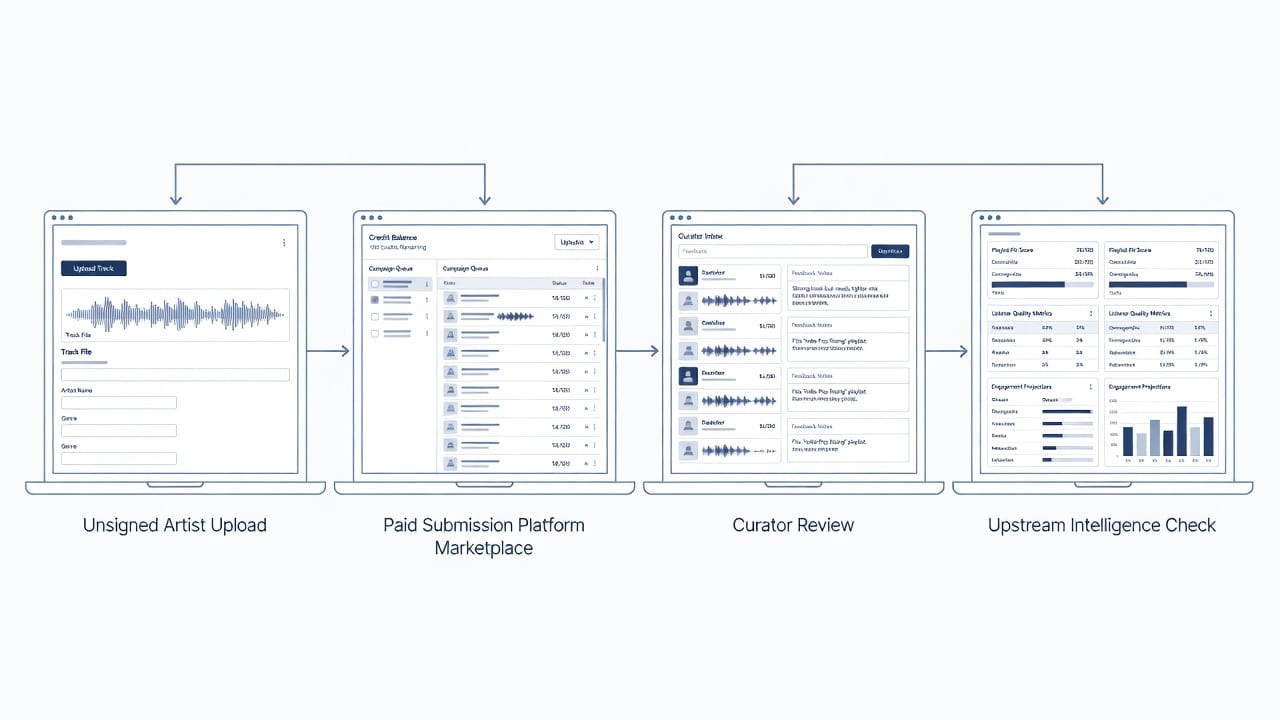
Playlist submission platforms are paid marketplaces connecting artists with curators for guaranteed song feedback. To succeed, artists must evaluate curator fit and playlist quality using upstream intelligence before spending credits.
What Are Playlist Submission Platforms?
Playlist submission platforms operate as two-sided digital marketplaces designed to solve the music industry's cold-start problem. On one side, independent artists purchase virtual credits to submit their newly released tracks. On the other side, playlist curators, bloggers, and influencers earn a portion of that fee in exchange for listening to the track and providing written feedback. If the curator likes the song, they may share it with their audience, though this placement is never guaranteed. This strict separation between payment and placement is what legally distinguishes these platforms from illegal payola schemes.
| Platform | Key Model Differences |
|---|---|
| SubmitHub | Granular genre tagging and strict feedback requirements |
| Groover | European-centric network with broader networking opportunities |
| PlaylistPush | Targets high-impact Spotify curators through larger campaign-level minimum spends |
Major playlist submission platforms
Why the Blind Pitch Model is Failing Indie Artists
These platforms originally emerged to democratize music promotion. Before their invention, artists had to blindly email MP3s to bloggers, hoping someone would open the attachment. By monetizing the curator's attention, platforms guaranteed that the music would at least be heard. However, as the creator economy exploded, the sheer volume of available curators diluted the quality of the networks. By 2026, an artist logging into a submission platform is faced with thousands of potential targets, many of whom manage playlists with dead followers, poor track positioning, or mismatched sonic profiles.
The core issue is that artists are forced to rely on manual, self-reported genre tags to find matches. A curator might tag their list as "Indie Pop," but their actual track history reveals a heavy bias toward lo-fi electronic beats. Pitching an acoustic indie track to this curator results in a guaranteed rejection and wasted credits. This inefficiency is why artists are seeking SubmitHub alternatives that actually use your music to find better matches. Instead of guessing based on text tags, modern post-release strategies require audio analysis to map the acoustic properties of a song directly to the historical acoustic properties of a curator's playlist.
When to Deploy Submission Campaigns
Playlist submission platforms are strictly post-release tools. Because curators require a live link to add a track to their Spotify or Apple Music playlists, campaigns cannot begin until the song is officially live on digital streaming providers (DSPs). Attempting to pitch unreleased private links through these specific marketplaces generally results in feedback-only responses, defeating the primary goal of securing active streams to trigger algorithmic growth.
The optimal window for deployment is within the first 14 to 28 days of a release. During this period, Spotify's algorithmic systems—such as Release Radar and Discover Weekly—are actively measuring user engagement metrics like save rates, skip rates, and playlist adds. Securing placements on highly engaged, niche-specific third-party playlists during this window feeds positive data back to the algorithm. However, timing is only effective if the routing is accurate. Artists must consult an intelligent playlist routing guide to map out exactly which curators to target before the release drops, ensuring that day-one marketing budgets are spent on high-probability matches rather than scattered testing.
How to Evaluate Platforms Before Spending
The most critical phase of using a playlist submission platform happens before you buy a single credit. The "analyze before you spend" methodology dictates that artists must treat SubmitHub, Groover, and PlaylistPush purely as delivery mechanisms, not as research tools. To evaluate a potential pitch, artists must look at three specific metrics: curator freshness, track position quality, and historical acceptance rates for specific sonic profiles.
Curator freshness measures how often a playlist is updated; a list that hasn't rotated tracks in three months is a dead investment. Track position quality analyzes where new additions are placed; if a curator buries new submissions at position 150 on a 200-song list, the placement will generate zero streams. Because the platforms themselves do not readily expose this negative data, artists use tools like PitchPlus to run these diagnostics. Understanding the realistic cost to submit music to Spotify playlists requires factoring in the cost of failed pitches. By applying an upstream intelligence layer to filter out dead or mismatched playlists, artists drastically reduce their cost-per-acquisition and improve their overall campaign ROI.
Who Benefits Most from Playlist Marketplaces?
The primary beneficiaries of these platforms are post-release independent artists who have a clearly defined sonic niche but lack the established industry connections to secure editorial playlisting. Genres with highly active, dedicated subcultures—such as Synthwave, Melodic Techno, Lo-Fi Hip Hop, and specialized Indie Folk—tend to see the highest return on investment. Curators in these spaces are constantly hunting for specific sounds to satisfy their highly engaged listener bases.
Conversely, artists producing broad, mainstream pop or highly experimental, cross-genre tracks often struggle on these platforms. Mainstream pop playlists are typically controlled by major labels or editorial teams, while highly experimental tracks defy the rigid genre categorization that submission platforms rely on. For these artists, the upstream analysis phase is even more critical, as they must identify micro-communities and highly specific mood-based playlists where their unique sound can find a foothold without relying on traditional genre labels.
Frequently Asked Questions
Do playlist submission platforms guarantee Spotify streams?
No. Playlist submission platforms only guarantee that a curator will listen to your track and provide feedback. Paying for guaranteed streams or guaranteed playlist placements is considered payola, which violates Spotify's terms of service and can result in your music being removed from the platform.
What is the difference between SubmitHub and Groover?
SubmitHub is known for its strict feedback requirements and highly granular genre filtering, making it popular for niche electronic and indie genres. Groover has a stronger presence in the European market and encourages broader networking, allowing artists to pitch to record labels and managers in addition to playlist curators.
Why do my submissions keep getting rejected despite matching the genre?
Rejections often occur because text-based genre tags are subjective. A curator's definition of "Indie Rock" might differ entirely from yours. This is why upstream intelligence tools that analyze the actual audio properties of your track against the curator's historical playlist data are necessary to improve acceptance rates.
How much should an independent artist budget for playlist pitching?
In 2026, a targeted post-release campaign typically requires between $150 and $300. However, this budget is easily wasted if applied blindly. Artists should allocate a small portion of their budget to upstream intelligence tools to analyze curator quality before spending the bulk of their funds on the actual submission credits.
Reading is the easy part.
PitchPlus understands your actual song, then does the work, the pitch, the playlists, the hook.
Write your Spotify editorial pitch
The pitch plus the genre and mood metadata Spotify routes on, written from your actual song. Not a 500 character box you fill in blind.
Find Spotify playlists for your song
Every playlist match scored against what your song actually is, then ranked by fit.
Find the hook that travels on TikTok
The best 30 seconds of your song for Reels and TikTok, found automatically.