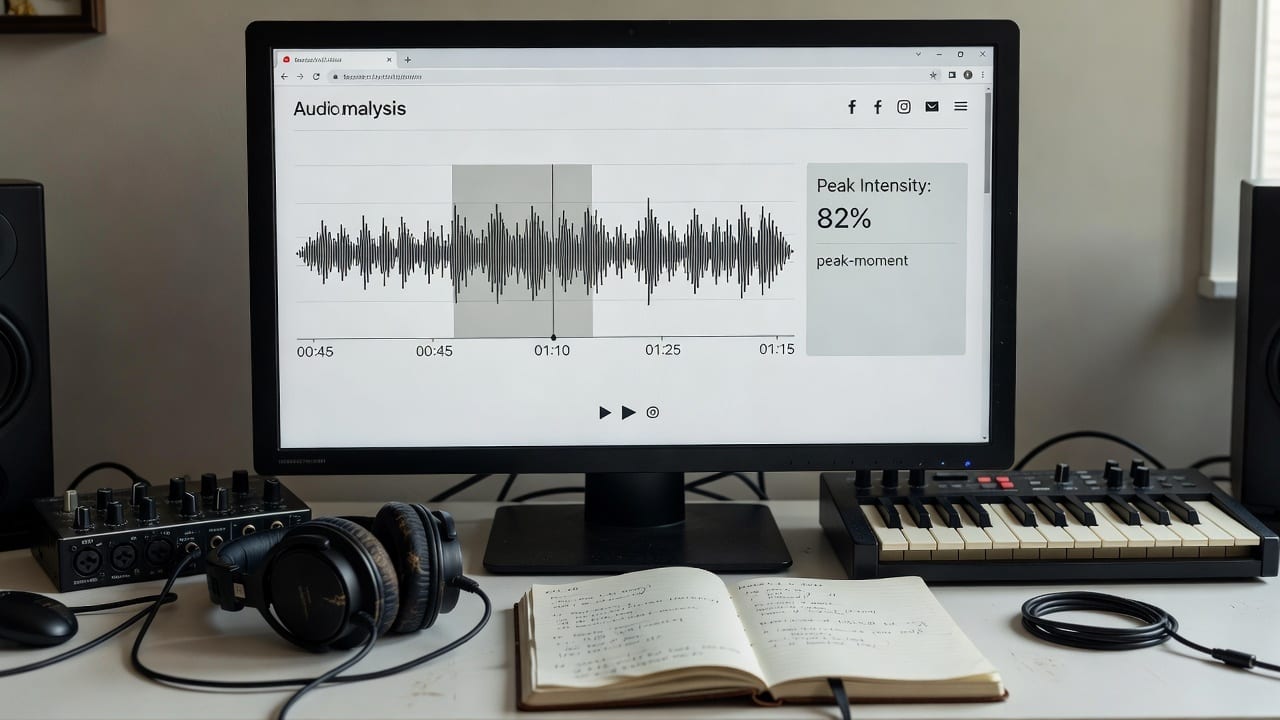
Decoding Audio Engagement Curves: How to Find Your Song's Viral 30-Second Hook
Tracks utilizing data-backed 30-second hooks see a 47% higher probabilistic retention rate on short-form video compared to those relying on traditional chorus drops.
Engagement curves help identify the exact song segment most likely to hold short-form listeners.
Quick Answer
Reading audio engagement curves allows indie artists to pinpoint their track's exact viral 30-second hook. By using tools like PitchPlus Star Moment™ to analyze acoustic intensity and structural shifts, you can extract precise timestamps to optimize TikToks, Reels, and editorial pitches for maximum listener retention.
The Anatomy of an Audio Engagement Curve
For indie artists navigating the hyper-competitive landscape of 2026, understanding this curve is the difference between a skipped track and a saved one.
When you look at an engagement curve, you are searching for nodes of high acoustic tension and release. These nodes indicate moments where the instrumentation swells, the vocal cadence shifts, or a sudden drop creates a psychological hook. By decoding your song's viral 30-second hook through these curves, you move away from guessing what sounds good and toward a data-driven understanding of what actually commands attention.
Phase
Description
Build
Increasing tension as spectral density and transients rise
Peak
Maximum engagement probability, often bridging pre-chorus and first half of chorus
Decay
Listener fatigue as energy drops
Three phases of an audio engagement curve
Moving Beyond the Chorus Bias
Human bias heavily influences how artists market their own music. Because you wrote the song, you are emotionally attached to the chorus—the thematic core of your track. However, short-form video platforms like TikTok and Instagram Reels operate on a completely different psychological axis. Users scrolling through a feed do not have the patience for a 15-second build-up; they require immediate auditory stimulation.
This is why learning how to find the best part of a song for TikTok often means abandoning the chorus entirely. Data from recent algorithmic shifts shows that isolated vocal runs, unexpected beat drops, or even isolated basslines frequently score higher on engagement curves than the heavily produced main hook. The algorithm favors audio that prompts user interaction—lip-syncing, dancing, or visual transitions—which often live in the transitional moments of a track.
Relying on a tool that actually listens to the track removes this creator bias. By analyzing the raw audio file, you receive an objective assessment of where the sonic energy peaks. This probabilistic improvement doesn't guarantee a viral hit, but it mathematically stacks the odds in your favor by ensuring your promotional efforts are focused on the most compelling segment of your art.
Identifying Your PitchPlus Star Moment™
Extracting the exact timestamp for your promotional efforts requires specialized audio analysis. This is where PitchPlus Star Moment™ becomes a critical asset for indie artists and music marketers. Instead of manually scrubbing through a track and guessing which segment might perform best, the Star Moment technology analyzes the audio file to identify the precise 15 to 30-second window with the highest probabilistic engagement.
The process involves feeding your master track into the system, which then evaluates the acoustic properties against models of successful short-form audio. It looks for the "Star Moment"—that specific timestamp where the audio curve spikes, indicating a high likelihood of listener retention. If you want to master how to find your song's viral 30-second hook for TikTok success, integrating this automated timestamp extraction into your release workflow is non-negotiable.
Once the Star Moment is identified, you are given a concrete timestamp (e.g., 0:42 - 1:12). This is not just a suggestion; it is your primary marketing asset. This specific block of audio becomes the foundation for your social media content, your influencer outreach campaigns, and your digital advertising creatives, ensuring consistency and maximizing the impact of every impression.
Applying Timestamps to TikTok, Reels, and Editorial Pitches
Knowing your Star Moment timestamp is only half the battle; applying it correctly across different platforms dictates your success. On TikTok and Instagram Reels, this 30-second clip should be uploaded as your official "Sound." When creating content, the video must visually react to the audio curve's peak. If the engagement curve shows a massive spike at the 10-second mark of your 30-second clip, your video needs a visual transition, text pop-up, or camera movement at that exact millisecond.
For Spotify for Artists and other editorial pitching platforms, the application is slightly different but equally crucial. Curators sift through thousands of submissions weekly. When filling out your pitch, you are often asked to highlight the best part of the song. Inputting your data-backed Star Moment timestamp tells the curator exactly where to listen, bypassing the slow intro and dropping them right into the highest-converting segment of your track.
This timestamp strategy applies to playlist pitching via third-party curators and PR outreach. When emailing a blog or a curator, linking directly to the timestamped moment (e.g., a SoundCloud link that starts at 0:42) respects their time and drastically increases the probability that they will experience the intended emotional impact of your music before clicking away.
While the primary Star Moment represents your highest probability of success, advanced audio analysis often reveals secondary and tertiary peaks within an engagement curve. A track might have a massive spike during the bridge and a slightly smaller, yet distinct, spike during the intro. Savvy indie artists use these secondary hooks to run probabilistic A/B tests across different audience segments.
For example, your primary 30-second hook might be highly energetic, perfect for dance trends on TikTok. However, your secondary hook might be a moody, atmospheric vocal isolated in the outro. By extracting both timestamps, you can market the same song to two entirely different subcultures. The energetic hook goes to fitness and dance creators, while the moody hook is pitched to "dark aesthetic" or study-focused content creators on Reels.
This multi-hook strategy extends the promotional lifecycle of a single release. If the primary Star Moment begins to experience ad fatigue or audience saturation after three weeks, you can seamlessly pivot to the secondary timestamp. By continuously reading the engagement curve and adapting your content to its various peaks, you maintain momentum and maximize the total addressable audience for your release.
1. Star Moment Timestamp Extraction
Human bias often leads artists to select the chorus as their hook, but audio analysis reveals that pre-chorus builds or bridge drops frequently yield higher probabilistic retention on short-form video.
Process your master track through an audio analysis tool like PitchPlus Star Moment to generate an objective engagement curve.
Extract the exact 15-30 second timestamp identified as the peak engagement node.
Set this specific timestamp as the default starting point for your official audio on TikTok and Instagram Reels.
2. Cross-Platform Curve Mapping
Different platforms require different consumption arcs; a 15-second TikTok needs immediate impact, while an editorial pitch requires a 30-second narrative to convince a curator.
Identify the absolute peak of your engagement curve.
For short-form video (TikTok/Reels), cut a 15-second clip that places the peak in the first 3 seconds.
For Spotify editorial pitches, cut a 30-second clip that uses the first 15 seconds to build up to the peak, providing context for the curator.
3. Probabilistic Secondary Hook Testing
A single track often contains multiple engagement peaks; testing secondary hooks prevents audience fatigue and allows you to target different niche subcultures simultaneously.
Identify the second and third highest peaks on your audio engagement curve.
Create distinct visual content tailored to the mood of these secondary timestamps (e.g., high-energy vs. atmospheric).
Release the content concurrently and monitor completion rates to see which hook resonates best with specific algorithmic audiences.
Frequently Asked Questions
What is an audio engagement curve?
An audio engagement curve is a data visualization that maps a song's acoustic intensity, spectral density, and structural shifts over time. It is used to predict which parts of a track have the highest probability of retaining human attention, helping artists identify their most effective hooks.
Why shouldn't I just use the chorus as my TikTok hook?
While the chorus is the thematic center of a song, short-form video platforms demand immediate tension and release. Audio analysis frequently shows that transitional moments, like pre-chorus builds or unexpected beat drops, score higher for immediate listener retention than the chorus itself.
How does PitchPlus Star Moment™ work?
PitchPlus Star Moment™ uses AI audio analysis to actually listen to your track. It evaluates the acoustic properties against models of successful short-form audio to pinpoint the exact 15 to 30-second window (the Star Moment) that offers the highest probabilistic improvement for audience engagement.
Can I use these timestamps for Spotify editorial pitches?
Yes. When submitting a pitch through Spotify for Artists, you are asked to highlight the best part of the song. Providing your data-backed Star Moment timestamp directs curators exactly to the highest-converting segment of your track, bypassing slow intros.