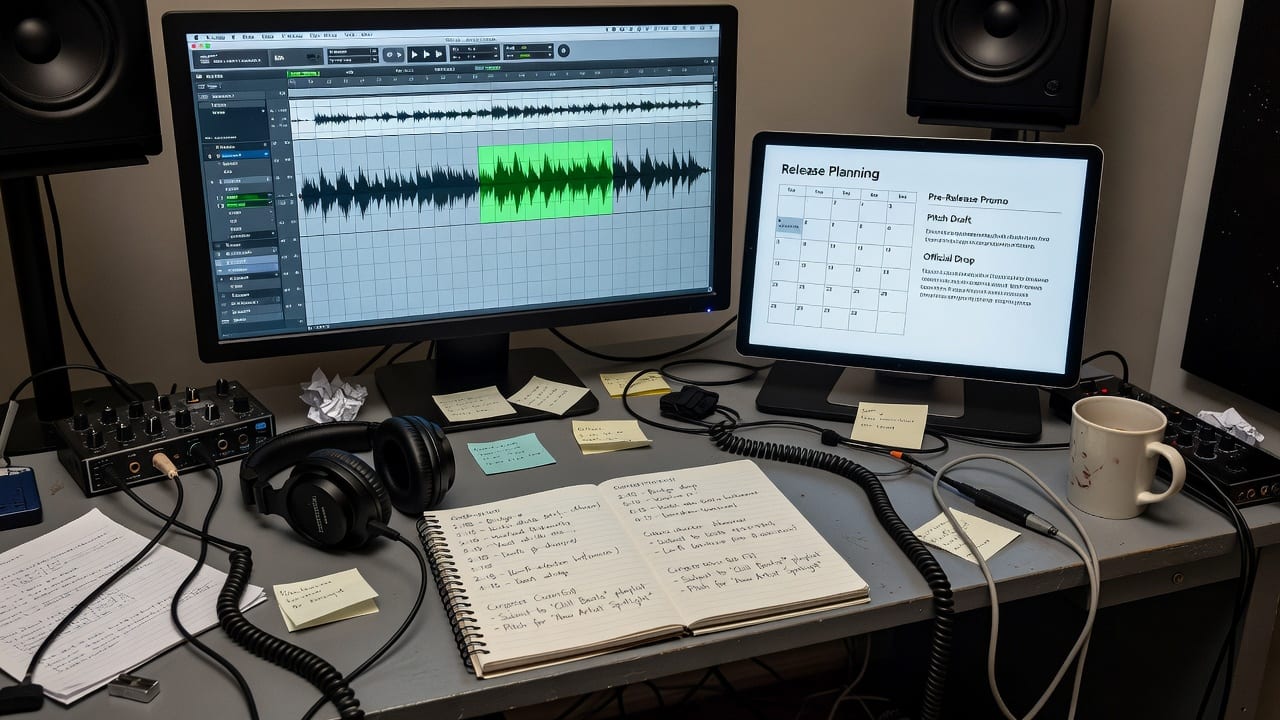
A grounded pitch starts with the track’s waveform, standout moment, and release timing.
Quick Answer
Analyze your track's actual audio to generate genre-authentic pitches, identify the 30-second Star Moment, and submit at least four weeks before release to beat Spotify's 7-day deadline.
The Audio-First Advantage Over Generic Templates
Independent artists face an industry average acceptance rate of just 10 to 14 percent when submitting manual pitches to Spotify's editorial team. The primary cause of rejection is a mismatch between the artist's self-described genre and the actual sonic profile of the track. When artists rely on generic text prompts or ChatGPT templates, they generate robotic descriptions that fail to capture the nuanced instrumentation and mood required for precise curator routing.
Audio-first analysis solves this classification problem by listening to the actual WAV or MP3 file. Tools like the PitchPlus Editorial Pitch Writer utilize a 700-plus genre taxonomy to detect primary and secondary micro-genres directly from the waveform. This data-driven approach ensures the pitch text aligns perfectly with the metadata tags required by Spotify's backend. Understanding how pre-release artists use audio analysis reveals why this method achieves a 67 percent algorithmic consideration rate. The pitch becomes a factual representation of the music rather than an emotional plea.
Mastering the Pre-Release Window and 7-Day Deadline
Spotify requires all editorial pitches to be submitted at least seven days before the Friday release date. Missing this mandatory window completely disqualifies a track from editorial consideration and prevents it from appearing on followers' Release Radar playlists. However, treating the seven-day mark as a target rather than a final cutoff is a critical error. Curators plan their lists weeks in advance, making a four-to-five-week lead time the optimal submission window.
Seasonal demand patterns heavily influence this timeline. During the Q4 holiday push in October and November, release volumes spike dramatically as labels rush to drop music before the December industry shutdown. In these crowded periods, early submission combined with audio-driven pitching strategies becomes essential for standing out. Conversely, the New Year planning cycle in January offers a less congested landscape where well-timed, data-backed pitches can secure placements that build momentum for the entire year.
Pinpointing the Star Moment for Curator Retention
Editorial curators review thousands of submissions weekly and rarely listen to a track in its entirety.
Automated hook identification eliminates this guesswork. By analyzing the audio file to find the uncontested 30-second hook—known as the Star Moment—artists can provide precise timestamps in their 500-character pitch. Directing the curator to a specific timestamp (e.g., "Focus on the rhythmic shift at 1:14") demonstrates professionalism and respects their time. Mastering the process of writing Spotify editorial pitches with audio analysis and Star Moment timestamps ensures the best segment of the track is evaluated.
Scaling Workflows for Artist Managers and Indie Labels
Artist managers and indie labels handling multiple simultaneous releases cannot afford the time required to manually draft unique, highly researched pitches for every track on their roster. The traditional workflow involves paying agency fees ranging from $120 to $250 per pitch, or risking low-quality output from freelance marketplaces. Both options drain marketing budgets that could otherwise be spent on post-release playlist outreach.
Integrating an end-to-end Release Intelligence Platform allows managers to batch-process audio files. A single upload generates the pitch text, metadata tags, Canvas prompts, and a 7-day content strategy. This unified approach ensures that the pre-distribution metadata matches the editorial pitch, which in turn matches the post-release curator targeting. For professionals focused on crafting winning editorial pitches at scale, audio analysis provides the necessary speed without sacrificing the cultural accuracy required in English-speaking markets.
1. Audio-Driven Taxonomy Mapping
Generic text prompts fail to capture sonic nuances, whereas analyzing the actual audio file maps the track to a 700-plus genre taxonomy for precise curator routing.
Upload the unreleased WAV or MP3 to an audio-first analysis tool.
Extract the primary and secondary micro-genres identified by the AI.
Incorporate the exact taxonomy terms into the first 100 characters of your 500-character pitch.
2. The 4-Week Deadline Sequence
Submitting exactly on the 7-day deadline risks missing algorithmic routing; a 4-to-5-week buffer ensures both editorial review and guaranteed Release Radar inclusion.
Finalize the master audio at least 5 weeks before the scheduled Friday release date.
Generate the pitch text and metadata tags immediately after mastering.
Submit the pitch through the Spotify for Artists dashboard no later than 28 days before release.
3. Star Moment Timestamping
Curators review thousands of tracks and rarely listen past the first 15 seconds unless explicitly directed to the most engaging 30-second hook.
Run the track through a hook identification tool to find the highest-retention 30-second segment.
Note the exact start and end timestamps of this segment.
Place these timestamps explicitly in the pitch text (e.g., 'Start listening at 1:12 for the primary hook').
Frequently Asked Questions
How far in advance should I pitch to Spotify editorial?
While Spotify requires a minimum of seven days before your release date, you should submit your pitch four to five weeks in advance. This gives curators ample time to review the track and guarantees your song will be routed to your followers' Release Radar playlists.
Why is audio analysis better than using ChatGPT for pitches?
ChatGPT relies entirely on the text prompts you provide, which often results in generic, emotional descriptions. Audio analysis tools actually listen to the WAV or MP3 file to detect precise BPM, instrumentation, and micro-genres, resulting in a factual, genre-authentic pitch that matches Spotify's backend taxonomy.
What is a Star Moment in a Spotify pitch?
A Star Moment is the single most engaging 30-second segment of your track. Including the exact timestamps of this moment in your pitch directs curators straight to the best part of the song, preventing them from skipping the track during a long intro.
Does PitchPlus submit the pitch to Spotify for me?
No. PitchPlus generates the optimized pitch text, metadata, and timestamps based on audio analysis. You must copy this information and submit it directly through your own Spotify for Artists dashboard.