How to Pitch to Spotify Editorial Playlists in 2026: The Indie Artist's Guide
Over 80% of generic Spotify editorial pitches are ignored instantly.
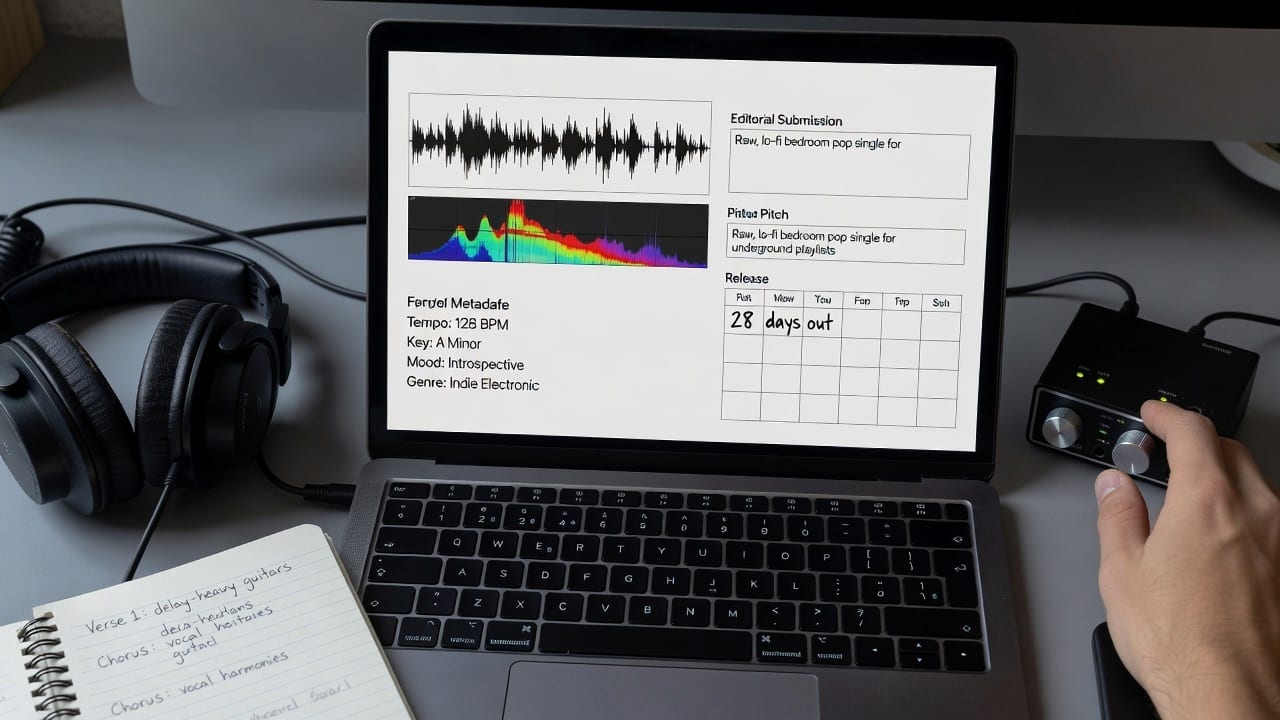
Submit genre-authentic, audio-driven pitches through Spotify for Artists at least seven days before release.
Prerequisites: Mastering the 2026 Spotify Editorial Timeline
Before drafting a single word of your pitch, you must understand the strict temporal mechanics of the Spotify for Artists ecosystem in 2026. The platform operates on a rigid ingestion schedule. If you miss the required windows, the quality of your music and the strength of your pitch become entirely irrelevant.
The optimal window for submission is exactly four weeks prior to your release date. This 28-day lead time gives Spotify's editorial team—who review thousands of tracks weekly—sufficient runway to categorize, listen to, and place your track. Understanding how far in advance you should pitch is the single biggest differentiator between artists who get heard and those who get buried in the queue.
If you are an indie artist staring down this 7-day window, you are in the danger zone.
Core Concepts: Why Audio-Driven Metadata Beats Generic Storytelling
The era of the "story-first" Spotify pitch is dead.
This shift means your pitch must be fundamentally audio-driven. Curators are looking for specific metadata: BPM, primary instrumentation, mood markers, and micro-genre classifications. A pitch that reads "This is a 120 BPM dark synth-pop track featuring analog Moog bass and breathy female vocals, perfect for late-night driving playlists" is infinitely more useful to a curator than a paragraph about your recent breakup.
Understanding why Spotify editorial playlists matter in this context is crucial. These playlists are no longer just human-curated mixtapes; they are data-driven environments. Your pitch must translate the raw audio of your track into the exact terminology curators use to search their internal databases.
Practical Application: How to Craft and Submit Your Pitch
Executing a successful pitch requires a systematic approach to the Spotify for Artists submission form. Step one is objective audio analysis. Before opening the pitch tool, you must strip away your emotional attachment to the song and analyze it like a musicologist. Identify the dominant instruments, the exact tempo, the cultural influences, and the specific sub-genres it bridges.
Step two is drafting the 500-character pitch. This is where most indie artists fail by relying on generic templates. You must synthesize your audio analysis into a dense, keyword-rich description. State the genre immediately, list the core sonic elements, mention the target mood, and name-drop 1-2 highly relevant existing Spotify playlists where the track belongs. If you want to write a Spotify editorial pitch that actually converts, every character must serve a descriptive purpose.
Step three is the actual submission, which often happens under extreme time pressure. For artists facing the dreaded 7-day deadline without a drafted pitch, the PitchPlus Spotify Editorial Pitch (Full Package) serves as a critical intervention. By generating genre-authentic pitches directly from your track's audio analysis, PitchPlus eliminates the guesswork and ensures you submit a highly targeted, data-backed pitch before the Release Radar window closes.
Advanced Techniques: Triggering the Algorithmic Ripple Effect
While landing an editorial playlist is the primary goal, advanced indie artists understand that the pitch itself is a data-entry tool for Spotify's algorithm. Even if a human curator passes on your track, the metadata you provide during the pitch process dictates how the algorithm treats your song post-release.
When you accurately tag your track's mood, genre, and instrumentation, you are training Spotify's algorithmic recommendation engine. This data directly influences Discover Weekly, Spotify Radio, and algorithmic autoplay features. If you tag a high-energy workout track as "chill acoustic," the algorithm will serve it to the wrong audience, resulting in high skip rates and a dead track.
To maximize this algorithmic ripple effect, you must pitch your song to Spotify playlists with surgical precision regarding your target audience. Look at your "Fans Also Like" section. If your audience overlaps with specific niche artists, ensure your pitch utilizes the same micro-genre terminology associated with those artists. This alignment signals to the algorithm exactly which listener clusters should receive your track on release day.
Expert Tips: Critical Pitching Mistakes to Avoid
The most common point of failure in 2026 is the misuse of AI text generators. Curators can instantly spot a generic, ChatGPT-generated pitch filled with flowery adjectives like "mesmerizing," "captivating," or "sonic journey." These words provide zero actionable data to a curator trying to fill a "Lofi Beats" or "New Music Friday" slot. Replace adjectives with concrete nouns and musical terms.
Another fatal error is misidentifying your genre to aim for larger playlists. Tagging an indie-folk song as "Pop" because Pop playlists have more followers guarantees rejection. Curators are highly specialized; the Pop curator will immediately discard your folk track, and the Folk curator will never even see it because it was routed to the wrong inbox.
Finally, never leave the pitch form incomplete. Spotify allows you to select multiple moods, styles, and instruments from their dropdown menus before you even reach the text box. Skipping these dropdowns or selecting them randomly undermines your written pitch. Ensure that the tags you select perfectly mirror the audio-driven data you highlight in your 500-character description.
Frequently Asked Questions
What happens if I pitch to Spotify less than 7 days before release?
If you pitch less than 7 days before your release date, you forfeit your guaranteed placement on your followers' Release Radar playlists. While the editorial team may theoretically still see the pitch, the lack of algorithmic support severely damages your track's initial momentum.
How long should a Spotify editorial pitch be?
Spotify limits the pitch text box to 500 characters (not words). Your pitch should be concise, data-dense, and focused entirely on the sonic profile, genre, instrumentation, and target mood of the track, utilizing as much of the 500-character limit as possible without adding fluff.
Can I pitch a song that has already been released?
No. The Spotify for Artists editorial pitching tool is exclusively for unreleased music. Once a track is live on the platform, it can no longer be pitched to the editorial team through this official channel.
Does pitching guarantee an editorial playlist placement?
No, pitching does not guarantee editorial placement due to the massive volume of submissions. However, pitching at least 7 days in advance does guarantee algorithmic placement on Release Radar, and the metadata you provide helps train the algorithm for future recommendations.
Reading is the easy part.
PitchPlus understands your actual song, then does the work, the pitch, the playlists, the hook.
Get your Spotify editorial pitch written
The pitch plus the genre and mood metadata Spotify routes on, written from your actual song. Not a 500 character box you fill in blind.
Match your song to the right Spotify playlists
Every playlist match scored against what your song actually is, then ranked by fit.
Find your song's viral hook
The best 30 seconds of your song for Reels and TikTok, found automatically.