How to Navigate and Succeed with the Spotify Algorithm Using Editorial Pitches
Artists who align their editorial pitches with Spotify's raw audio analysis see up to 3x higher algorithmic playlist placement in their first week.
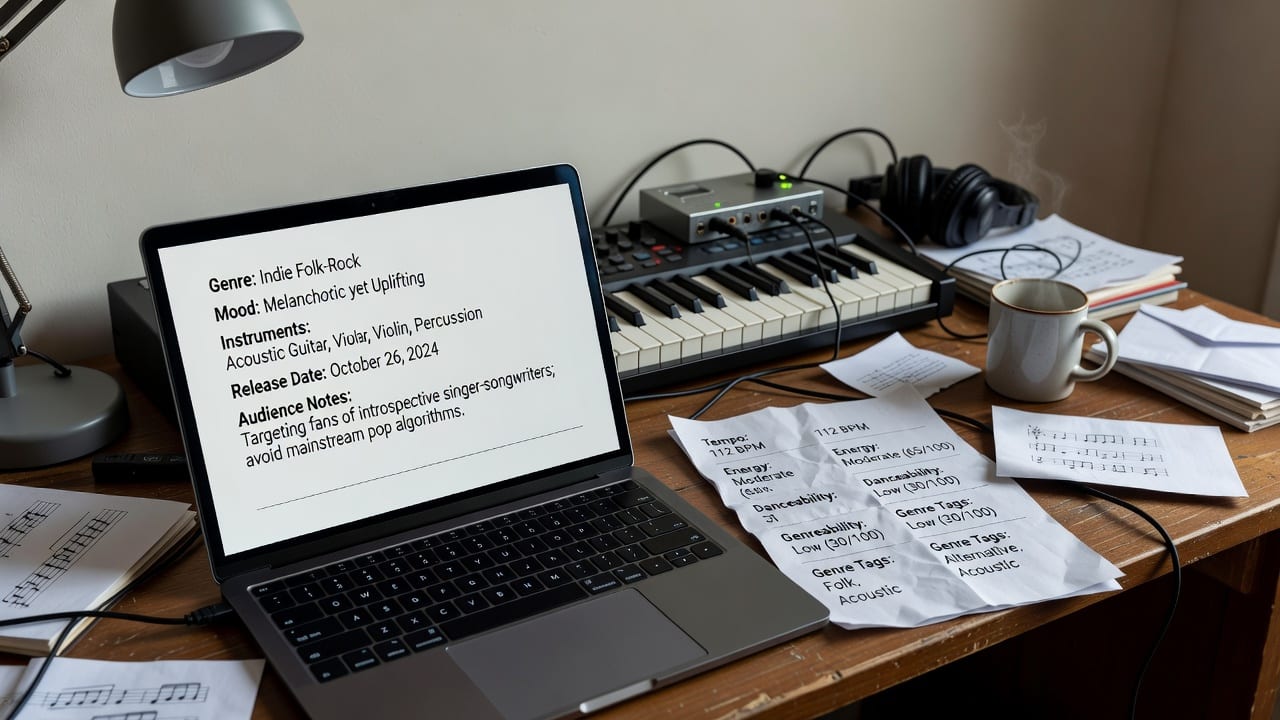
Editorial pitches feed Spotify's BaRT algorithm critical metadata before release. By submitting genre-authentic pitches 2-4 weeks early, independent artists trigger Release Radar and Discover Weekly algorithms, driving guaranteed initial reach.
Prerequisites: When and Who Should Pitch
Before writing a single word of your pitch, you must establish the correct foundation within the Spotify ecosystem. The editorial pitching process is exclusively available to artists who have claimed their Spotify for Artists profile and have unreleased music delivered to the platform by their distributor.
Timing dictates algorithmic success. You must submit your pitch during the 2-4 week pre-release timing window. Submitting earlier than four weeks risks your track getting buried under newer submissions, while pitching less than seven days before release guarantees you will miss the algorithmic cutoff for Release Radar placement.
This guide applies to independent artists preparing a new single, EP, or album. If you are releasing a compilation, a remix of an already released track, or if you missed the seven-day window, the editorial pitch tool will be locked. In those scenarios, your focus must shift entirely to post-release engagement strategies rather than pre-release metadata seeding.
Core Concepts: What the Spotify Algorithm Actually Wants
To beat the algorithm, you must understand how it processes information. Spotify's BaRT recommendation engine (Bandits for Recommendations as Treatments) does not just look at listener behavior; it actively reads your pitch using Natural Language Processing (NLP). The algorithm scans your submission for keywords, mood indicators, and genre tags to build an initial profile of your song before anyone has heard it.
Simultaneously, Spotify runs raw audio analysis on your uploaded file. The system measures tempo, key, energy, acousticness, and danceability. The algorithm's primary goal during the pre-release phase is to verify that the metadata you provide in your pitch matches the sonic reality of your audio file.
A mismatch such as tagging a high-energy electronic track as chill acoustic destroys algorithmic trust, resulting in suppressed reach during your crucial first week.
Practical Application: How to Submit a Winning Editorial Pitch
Executing a successful pitch requires precision inside the Spotify for Artists dashboard. Follow these exact steps to ensure your metadata feeds the algorithm correctly.
Step 1: Select the Right Track
Navigate to the 'Upcoming' tab in your dashboard. If you are releasing an EP or album, you can only pitch one track. Choose the song with the strongest immediate hook, as editors and algorithms prioritize tracks that prevent early listener drop-off.
Step 2: Define Your Micro-Genres and Moods
Spotify allows you to select up to three genres and sub-genres, along with specific moods and song cultures. Do not choose aspirational genres. Select the exact micro-genres that describe the sonic reality of the track. If your song is "Dark Synthpop," do not just tag "Pop." The algorithm uses these tags to place your song alongside similar artists in algorithmic radio.
Step 3: Craft the Written Pitch
You have 500 characters to tell your story. Writing Spotify editorial pitches requires a balance of data and narrative. Dedicate the first sentence to the exact instrumentation and vibe. Use the second sentence to highlight your marketing drivers—mention specific TikTok campaigns, pre-save numbers, or upcoming tours. The final sentence should name-drop 2-3 similar artists to feed the NLP engine direct comparative data.
Step 4: Review and Submit
Double-check your location tags and language selections. A common mistake is tagging the location of your distributor rather than your actual local music scene. Localized tags trigger regional algorithmic playlists, which are highly engaged. Submit the pitch and monitor your dashboard for the "Pitch Submitted" confirmation.
Advanced Techniques: Using Audio Analysis for Genre-Authentic Pitches
The most common reason independent artists fail to trigger the algorithm is the gap between human perception and machine listening. You might think your track sounds like mainstream indie rock, but Spotify's raw audio analysis might categorize its drum patterns and synth layers as alternative pop. If you pitch based on your human bias, you create a metadata mismatch.
This is where PitchPlus audio analysis becomes a critical pre-release tool. By running your unreleased track through PitchPlus, you receive a precise breakdown of the exact micro-genres, moods, and energy levels a machine-learning model detects. This data allows you to reverse-engineer your submission.
Instead of guessing your tags, you input the exact data points the algorithm is already preparing to assign to your track. This strategy is the foundation of accepted Spotify editorial pitches in 2026. When your PitchPlus-informed submission perfectly mirrors Spotify's internal audio scan, you build immediate algorithmic authority, resulting in highly targeted algorithmic playlisting that drives genuine fan discovery.
Expert Tips: What Success Looks Like in 2026
Success with editorial pitching is rarely an immediate placement on Today's Top Hits.
Monitor your "Listeners Also Like" section closely in the weeks following your release. If your pitch was genre-authentic and algorithmically aligned, this section will populate with artists who share your exact target audience. If random, unrelated artists appear, your pitch metadata was likely too broad or inaccurate.
Finally, track your save-to-listener ratio. Algorithmic playlists generated by a strong pitch put your music in front of highly targeted users. A healthy save rate (above 10%) signals to the BaRT engine that the initial algorithmic test was successful, triggering secondary waves of algorithmic reach via Discover Weekly and Spotify Radio.
Frequently Asked Questions
How long before release should I submit my Spotify editorial pitch?
You should submit your pitch 2 to 4 weeks before your release date. Submitting at least 7 days prior guarantees placement on your followers' Release Radar, but giving editors 3-4 weeks provides ample time for human review and algorithmic processing.
Does an editorial pitch guarantee algorithmic placement?
Submitting a pitch at least 7 days early guarantees your track will appear on the Release Radar of your followers. However, broader algorithmic reach (like Discover Weekly or algorithmic radio) depends entirely on how well your pitch metadata matches the track's actual audio profile and early listener engagement.
How does PitchPlus help with Spotify pitching?
PitchPlus analyzes your raw audio file to identify the exact micro-genres, moods, and sonic characteristics that machine-learning algorithms detect. This allows you to write a genre-authentic pitch that perfectly aligns with Spotify's internal audio scan, building algorithmic trust and boosting your pre-release authority.
Can I edit my Spotify pitch after submitting it?
Yes, you can edit your pitch up until the release day. However, frequent late changes can disrupt the algorithmic categorization process. It is best to use audio analysis tools to get your metadata right on the first submission.
Reading is the easy part.
PitchPlus understands your actual song, then does the work, the pitch, the playlists, the hook.
Build your Spotify pitch and metadata
The pitch plus the genre and mood metadata Spotify routes on, written from your actual song. Not a 500 character box you fill in blind.
Find the Spotify playlists you fit
Every playlist match scored against what your song actually is, then ranked by fit.
Find your best 30 seconds for Reels
The best 30 seconds of your song for Reels and TikTok, found automatically.