How to Identify Optimal Playlists for Post-Release Promotion Using Smart Tools
Smart playlist finders boost curator acceptance rates by 3-4x.
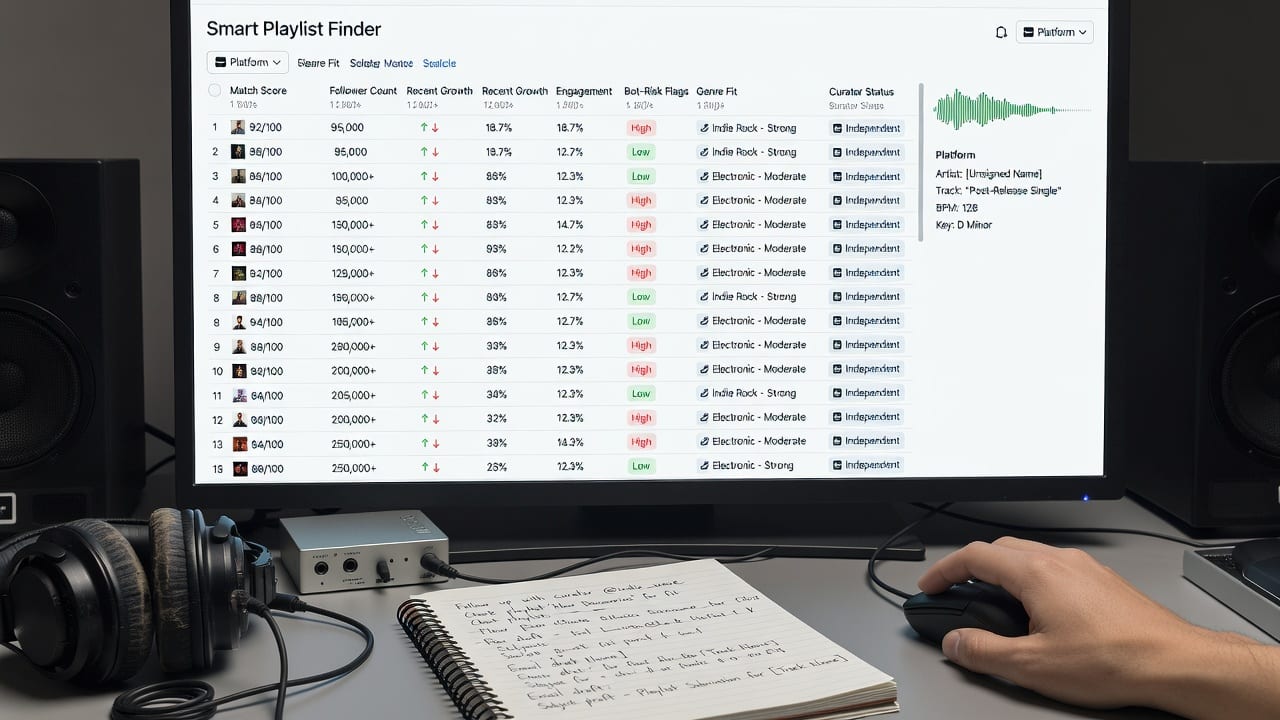
Learn to rank 44,000+ playlists, filter bots, and route tracks to the right curators post-release.
Prerequisites for Post-Release Playlist Outreach
Independent artists must shift their promotional strategy the moment a track goes live. The pre-release window belongs to Spotify editorial pitches, which require submission at least seven days before a Friday release. Once release day hits, the focus moves entirely to independent curator networks. Attempting to pitch editorial teams post-release is a structural impossibility within Spotify for Artists.
The industry average for blind pitching on platforms like SubmitHub or Groover hovers around 10 to 14 percent.
Artist managers handling multiple simultaneous releases face an amplified version of this problem. Managing a roster requires scalable workflows that prevent wasted spend across dozens of tracks. A data-driven approach requires abandoning manual keyword searches on Spotify in favor of automated tools that analyze actual curator behavior and track performance.
Core Concepts of Upstream Playlist Intelligence
A upstream intelligence layer sits between the artist and the submission platform. Instead of logging directly into a curator network and guessing which playlists fit a song, artists use a smart finder to analyze the landscape first. This software evaluates playlists based on genre fit, update frequency, and historical acceptance data before any money changes hands.
PitchPlus operates a Smart Playlist Finder that monitors over 44,000 playlists across SubmitHub, Groover, and Unhurd. The system updates every 48 hours to track which curators are actively placing new music and which have abandoned their lists. This freshness scoring prevents artists from pitching to curators who haven't logged in or updated their tracklists in months.
Audio-first analysis forms the foundation of accurate matching. Rather than relying on artist-provided text tags—which carry an 80 percent metadata error rate—the tool listens to the actual MP3 or WAV file. It detects the primary and secondary genres, instrumentation, and mood, matching those sonic characteristics against the historical preferences of specific curators.
How to Implement a Smart Playlist Finder for Your Track
Step 1: Upload the Audio File Begin by uploading the final master audio file into the analysis engine. Bypassing text prompts ensures the system categorizes the track based on its actual sonic profile. The AI will identify the precise sub-genres and mood markers that curators actually look for, rather than the broad categories artists often self-assign.
Step 2: Review the Ranked Matches The system generates a prioritized list of targets. When locating best-fit playlists, look at the freshness score and position quality first. A playlist that places new submissions in the top 10 spots holds significantly more value than one that buries new tracks at position 150. The PitchPlus tool ranks 75 best matches tailored specifically to the uploaded audio.
Step 3: Execute Platform Routing Smart tools do not just provide a list of names; they recommend the specific platform where a curator is most active. If a highly matched curator maintains profiles on both SubmitHub and Groover, the routing engine will indicate which platform yields faster response times or higher approval rates for that specific genre. Artists then purchase credits only on the recommended platform for those exact curators.
Advanced Strategies: Batch Scanning and Platform Routing
Artist managers and indie labels must process multiple tracks simultaneously, especially during the Q4 holiday push when release volumes spike. Batch scanning allows managers to upload an entire EP or roster release schedule at once. The intelligence layer maps out a distinct curator strategy for each track, ensuring that a synth-pop single and an acoustic ballad from the same artist do not get pitched to the same generic indie lists.
Cross-platform routing optimizes the total campaign budget. Certain European electronic curators exhibit higher engagement rates on Groover, while North American indie-rock bloggers often prefer SubmitHub. By following the routing recommendations of a smart finder, managers achieve a 3-4x acceptance improvement over blind pitching on a single platform.
Integrating the 30-second Star Moment into the pitch text further increases conversion. When submitting to the identified playlists, including the exact timestamp of the track's strongest hook proves to the curator that the submission is tailored and respects their time. This audio-backed precision separates professional pitches from generic, template-driven outreach.
Expert Tips on Avoiding Bots and Timing Submissions
Playlist bot detection remains a critical component of post-release strategy in 2026. Fraudulent playlists use artificial streaming farms to inflate their follower counts, offering zero actual listener engagement. Pitching to these lists wastes money and risks triggering Spotify's algorithmic penalties for artificial streaming.
A reliable smart tool filters bot-driven lists by analyzing follower growth velocity. If a playlist gains 10,000 followers overnight without a corresponding spike in active listeners or social media virality, the system flags it as artificial and removes it from the recommendation pool. Artists should never pitch to a list that lacks a verifiable, organic growth curve.
Timing dictates campaign success. The New Year planning cycle in January presents a massive opportunity, as curators return from the December industry shutdown with fresh ears and empty slots. Conversely, pitching during late November requires hyper-targeted routing, as curators are flooded with Q4 releases. Always run a fresh scan 48 hours before pitching, as playlist activity metrics shift rapidly during these seasonal transitions.
Frequently Asked Questions
When should I start using a smart playlist finder?
You should deploy a smart playlist finder immediately after your Friday release date. Once the mandatory seven-day Spotify editorial pitch window closes, your promotional focus must shift entirely to independent curator networks and post-release outreach.
How does audio-first ranking differ from text-based searches?
Audio-first tools listen to the actual MP3 or WAV file to determine precise sub-genres, instrumentation, and mood. Text-based searches rely on artist-provided metadata, which carries an 80 percent error rate and often leads to mismatched pitches and rejected submissions.
Does a playlist finder replace SubmitHub or Groover?
No. A smart playlist finder acts as an upstream intelligence layer. It analyzes 44,000+ playlists to tell you exactly which curators to target and which platform to use, ensuring you do not waste submission credits on inactive or mismatched lists.
How are bot playlists filtered out of the recommendations?
The system monitors playlist freshness, follower growth velocity, and position quality every 48 hours. Playlists that exhibit unnatural follower spikes without corresponding active listener engagement are flagged as artificial and excluded from your ranked matches.
Reading is the easy part.
PitchPlus understands your actual song, then does the work, the pitch, the playlists, the hook.
Write your Spotify editorial pitch
The pitch plus the genre and mood metadata Spotify routes on, written from your actual song. Not a 500 character box you fill in blind.
Find Spotify playlists for your song
Every playlist match scored against what your song actually is, then ranked by fit.
Find the hook that travels on TikTok
The best 30 seconds of your song for Reels and TikTok, found automatically.