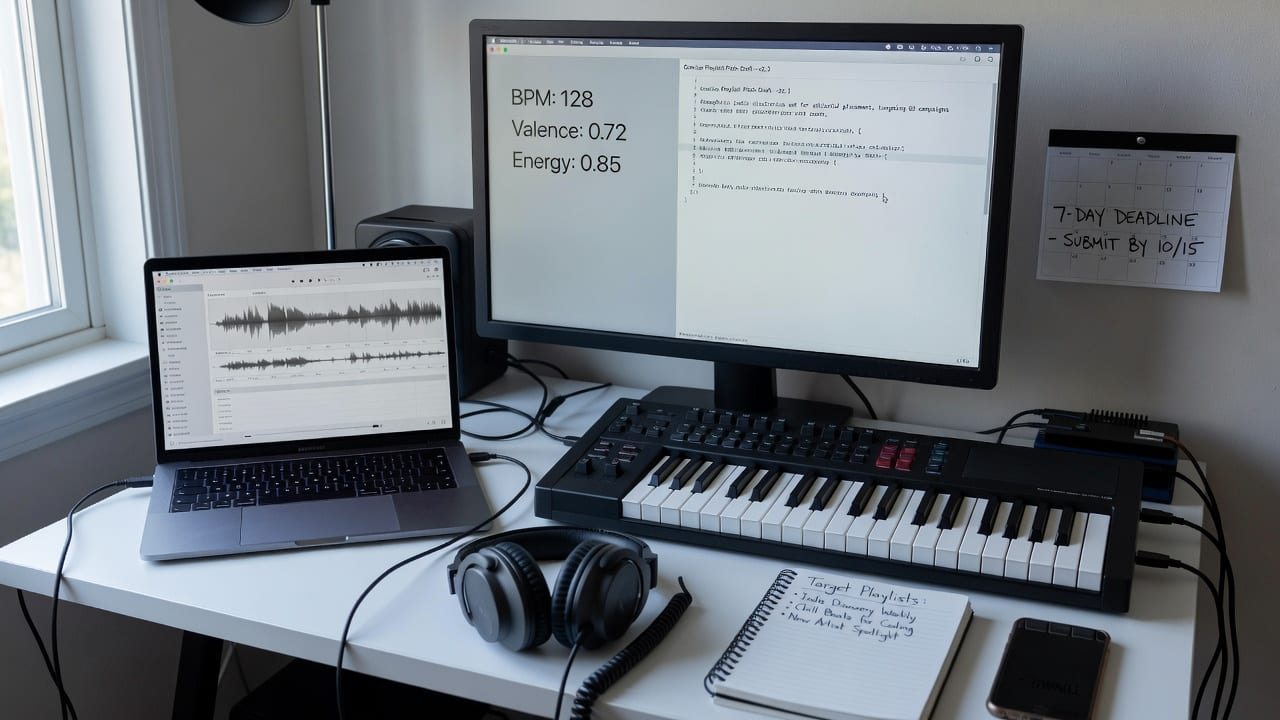
Audio analysis turns a generic playlist pitch into a timed, evidence-based submission.
Quick Answer
Replace generic templates with audio analysis metrics submitted four weeks before your release date.
Prerequisites: The Foundation of Spotify Pitching Basics
Before deploying advanced audio analysis, indie artists must master the basic mechanics of the Spotify for Artists (S4A) dashboard. The platform restricts editorial pitches to a strict 500-character limit, alongside a series of metadata dropdown menus covering genre, mood, instrumentation, and recording location. This character constraint forces artists to abandon lengthy biographies and focus entirely on the music's sonic identity. A successful pitch requires a verified S4A profile, a scheduled unreleased track delivered by a distributor, and a clear understanding of the target audience in English-speaking markets.
Every character spent on backstory is a character stolen from explaining why the track fits a specific editorial ecosystem.
The internet is flooded with free pitch templates from platforms like Fanpage. These templates rely heavily on generic adjectives—describing tracks as 'a whole vibe,' 'chill,' or 'energetic'—which provide zero actionable data to a playlist curator. Curators organize playlists based on strict sonic metadata and acoustic profiles. When an artist uses a copy-paste template, they blend into a sea of thousands of identical, subjective submissions that fail to communicate the track's actual utility.
Audio analysis fundamentally changes this dynamic by translating music into data. By extracting specific metrics like BPM, valence (musical positiveness), energy, and acousticness, artists can speak the exact language of Spotify's backend algorithm. How Indie Artists Can Create Winning Spotify Editorial Pitches Using Audio Analysis demonstrates that replacing subjective narratives with hard audio data allows curators to instantly visualize where a track belongs. If a curator is building the 'Deep Focus' playlist, a pitch highlighting a 'low-valence, 60 BPM acoustic arrangement with minimal transient peaks' is infinitely more useful than one claiming the song is 'great for studying late at night'.
Practical Application: Step-by-Step Implementation in Pitch Creation
Implementing audio analysis requires translating raw sonic data into a compelling, genre-authentic narrative within the 500-character limit. Start by identifying the track's primary acoustic traits. Is the instrumentation organic or electronic? Does the rhythm section drive the energy, or is it led by atmospheric, washed-out synths? Map these traits directly to the specific editorial playlists you are targeting. A pitch for 'Lorem' requires a vastly different sonic description than a pitch for 'New Music Friday'.
For artists who lack the technical background to extract these metrics manually, the PitchPlus Spotify Editorial Pitch (Full Package) provides a distinct advantage. Unlike automated generators that scrape basic metadata, this service actually listens to the track to build a custom, data-driven pitch that captures the nuance of indie music. How to Write a Genre-Authentic Spotify Editorial Pitch Using Audio Analysis outlines how integrating professional audio analysis ensures the pitch aligns perfectly with the sonic expectations of English-speaking curators, bridging the gap between raw data and human emotion.
Advanced Techniques: Highlighting the Star Moment
Directing the curator to 'Skip to 0:45 for the primary bass drop and vocal hook' respects their time and guarantees they hear the strongest part of the composition.
Include this timestamp directly in the opening line of the pitch text. Directing the curator to 'Skip to 0:45 for the primary bass drop and vocal hook' respects their time and guarantees they hear the strongest part of the composition. How to Write Genre-Authentic Spotify Editorial Pitches Using Audio Analysis shows that timestamping prevents premature skips and provides immediate proof of genre authenticity. It signals to the curator that you understand exactly what makes your track competitive in the current streaming landscape.
Expert Tips: Mastering the 4-Week Pre-Release Window
Timing dictates the success of even the most data-rich, perfectly crafted pitch. The absolute minimum lead time for a Spotify editorial submission is 28 days. This 4-week pre-release window serves two critical functions. First, it guarantees the track will automatically populate on the Release Radar playlists of all your current followers, securing baseline algorithmic streams on release day regardless of editorial placement.
Second, it provides human curators adequate time to review the submission, discuss it during weekly editorial meetings, and slot it into upcoming playlist updates. Submitting a pitch one week before release effectively eliminates any chance of editorial consideration, as those playlists are already locked. The 2026 Guide to Crafting a Spotify Editorial Pitch with Audio Analysis emphasizes that indie artists must finalize their masters and schedule their distribution at least five weeks out to comfortably hit this 28-day pitching window without rushing the data analysis phase.
1. Audio-Driven Narrative Construction
Curators filter submissions using sonic metadata like BPM and valence rather than subjective adjectives.
Extract track BPM, valence, and energy levels using audio analysis tools.
Map these specific metrics to the sonic profile of your target editorial playlist.
Draft a 500-character pitch leading with these hard data points instead of artist biography.
2. The 4-Week Pre-Release Window
Submitting 28 days early guarantees Release Radar inclusion and gives curators adequate review time.
Finalize track masters and artwork five weeks before the intended release date.
Upload the release to your distributor immediately to ensure ingestion by Spotify.
Submit the S4A pitch exactly 28 days prior to launch to maximize editorial meeting cycles.
3. Star Moment Timestamping
Editorial curators review thousands of tracks and often skip ahead if the intro drags.
Identify the peak emotional or sonic moment of the track (the hook or drop).
Format this exact timestamp (e.g., 'Skip to 0:45') prominently in the first sentence of the pitch.
Explain briefly why this specific moment defines the track's genre authenticity.
Frequently Asked Questions
Why is a 4-week pre-release window necessary for Spotify pitches?
Submitting your pitch 28 days before release guarantees your track will appear on your followers' Release Radar playlists. It also gives Spotify's editorial team enough time to review the track, discuss it in curation meetings, and program it into upcoming playlist updates before the slots fill up.
How does audio analysis improve a Spotify editorial pitch?
Audio analysis replaces subjective adjectives with objective data like BPM, valence, and energy. Curators use these exact metrics to organize playlists, so providing this data helps them instantly understand where your track fits within their specific editorial ecosystem.
Why shouldn't I use free pitch templates?
Free templates from sites like Fanpage rely on generic phrasing that thousands of other artists use. They waste the strict 500-character limit on filler words rather than providing the concrete sonic metadata curators need to make placement decisions.
What is a 'Star Moment' in a Spotify pitch?
The Star Moment is the exact timestamp (e.g., 0:45) where your track reaches its peak sonic or emotional impact. Including this in your pitch directs time-strapped curators straight to the best part of the song, preventing them from skipping during a long intro.