How Indie Artists Use Smart Playlist Finders to Target Live Curators Post-Release
82% of indie playlist pitching budgets are wasted on inactive curators.
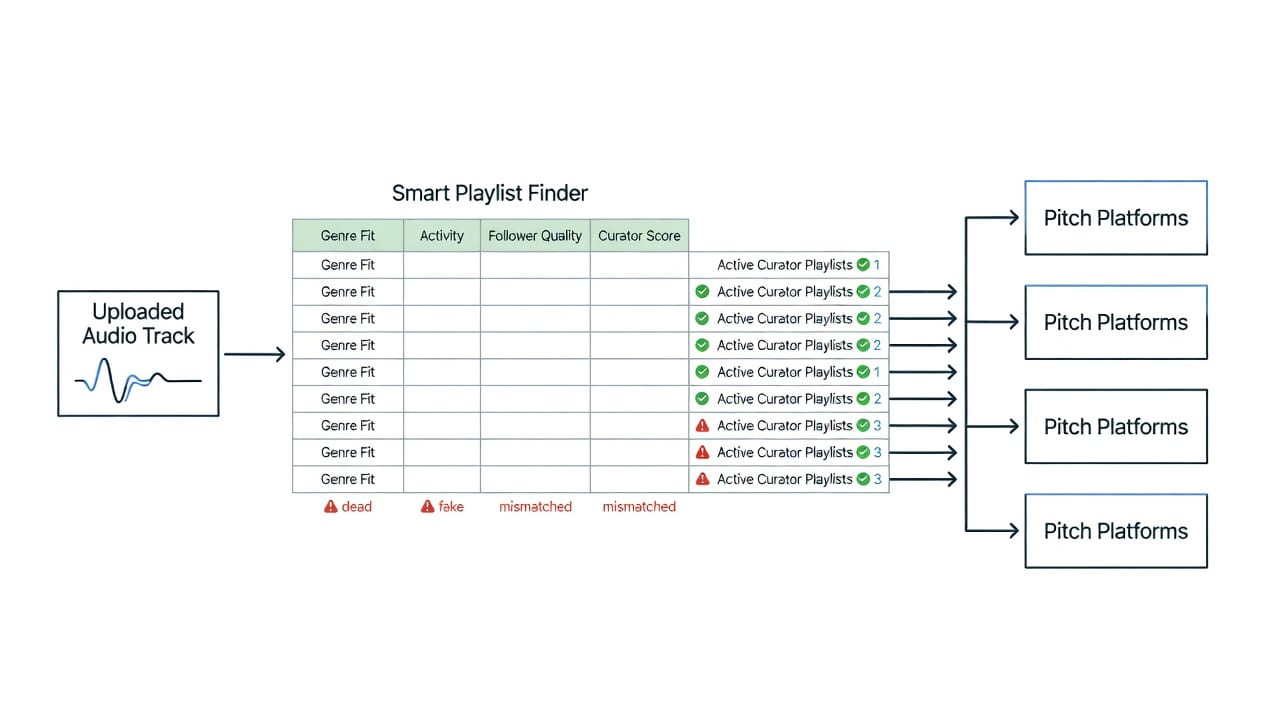
Master using smart playlist finders to identify 75 active curators post-release, optimizing your SubmitHub budget.
Prerequisites: Understanding the 2026 Post-Release Window
The post-release window dictates the trajectory of an independent track in 2026. With over 120,000 new songs hitting streaming platforms daily, the first 28 days after release are critical for triggering algorithmic discovery. Indie artists often make the mistake of treating pre-release and post-release pitching as identical processes. Pre-release pitching focuses exclusively on editorial teams via Spotify for Artists. Post-release pitching requires targeting independent, third-party curators who manage active listener communities.
Blindly submitting tracks to submission platforms without prior research drains independent budgets rapidly. Artists must understand their exact sub-genre, target audience demographics, and the specific mood of their release before spending a single dollar. You need a finalized Spotify URI, high-quality press assets, and a clear understanding of your track's sonic profile. Attempting to pitch unreleased tracks to third-party live curators results in immediate rejections, as these curators require playable links to evaluate playlist flow.
Core Concepts: The Upstream Intelligence Layer
Submission platforms like SubmitHub, Groover, and Unhurd are execution networks, not discovery engines. They facilitate the transaction of sending a song to a curator, but they do not tell you if that curator's audience actually aligns with your music. This gap necessitates an upstream intelligence layer. By analyzing playlist data before opening your wallet, you shift from a spray-and-pray approach to a targeted sniper strategy.
The PitchPlus Smart Playlist Finder serves exactly this function. Instead of scrolling through thousands of unverified lists, the tool ranks 75 live playlists specifically optimized for post-release artists. It evaluates over 44,000 entries, scoring them based on genre fit, curator responsiveness, and playlist freshness. Freshness is a critical 2026 metric; a playlist with 10,000 followers that hasn't been updated in six months yields zero active streams. Upstream intelligence ensures your budget is only allocated to curators who actively manage their track sequencing and listener engagement.
1. Input track metadata
Input your track's metadata into the intelligence tool. You must provide the exact BPM, primary genre, secondary sub-genres, and the emotional resonance (mood) of the song. Broad categorizations like "Pop" or "Rock" fail in modern pitching; you must specify "Dark Synth-Pop" or "Shoegaze Indie Rock" to generate accurate matches.
2. Filter the database
Filter the database. Learning how to use a smart playlist finder effectively means setting strict parameters for listener retention and curator activity. Eliminate any playlist where the curator hasn't added a new track in the last 14 days. Filter out playlists with erratic follower spikes, which often indicate bot activity. Your goal is to isolate the PitchPlus top 75 live playlists that demonstrate steady, organic listener growth.
3. Export and cross-reference
Take your refined list of 75 high-fit curators and locate them on your preferred submission platforms. Because you have already verified their audience alignment and activity status, you can confidently allocate premium credits to these specific targets, bypassing the generic platform recommendations entirely.
Executing a successful post-release campaign requires a strict operational workflow. Step one involves inputting your track's metadata into the intelligence tool. You must provide the exact BPM, primary genre, secondary sub-genres, and the emotional resonance (mood) of the song. Broad categorizations like "Pop" or "Rock" fail in modern pitching; you must specify "Dark Synth-Pop" or "Shoegaze Indie Rock" to generate accurate matches.
Step two requires filtering the database. Learning how to use a smart playlist finder effectively means setting strict parameters for listener retention and curator activity. Eliminate any playlist where the curator hasn't added a new track in the last 14 days. Filter out playlists with erratic follower spikes, which often indicate bot activity. Your goal is to isolate the PitchPlus top 75 live playlists that demonstrate steady, organic listener growth.
Step three is the export and cross-reference phase. Take your refined list of 75 high-fit curators and locate them on your preferred submission platforms. Because you have already verified their audience alignment and activity status, you can confidently allocate premium credits to these specific targets, bypassing the generic platform recommendations entirely.
Success in post-release pitching is not defined by the sheer number of playlist placements, but by the quality of listener retention.
Once you have your targeted list, budget allocation becomes a mathematical exercise rather than a guessing game. Different curators operate exclusively on different platforms. Some prefer the structured feedback loop of SubmitHub, while others utilize Groover's European-centric network or Unhurd's direct-to-fan models. Cross-referencing your upstream intelligence data against these platforms allows you to split a $100 budget efficiently across 30 highly targeted pitches rather than 100 low-probability submissions.
Advanced artists utilize A/B testing during this phase. Split your 75 targeted playlists into two tiers based on their PitchPlus match score. Pitch Tier 1 (the top 35 matches) in week one of your post-release window. Monitor the approval rates and the subsequent stream-to-listener ratio on your Spotify for Artists dashboard. If the data shows strong algorithmic triggering (such as appearances on Discover Weekly or Release Radar), deploy the remaining budget to Tier 2 in week three to sustain the momentum. This phased approach is the cornerstone of finding real Spotify curators post-release without exhausting your resources on day one.
Expert Tips: Defining and Measuring Success
Success in post-release pitching is not defined by the sheer number of playlist placements, but by the quality of listener retention. A placement on a mismatched playlist with 50,000 followers will result in high skip rates, actively damaging your track's algorithmic standing on Spotify. Conversely, a placement on a hyper-niche playlist with 500 dedicated followers who listen to the track entirely signals positive engagement to the algorithm.
Track your approval rate as the primary indicator of your targeting accuracy. The industry average for blind pitching hovers around 5-8%. When utilizing upstream intelligence to target 75 verified live playlists, artists should expect an approval rate between 25% and 35%. Monitor your "Saves" and "Playlist Adds" metrics inside Spotify for Artists 48 hours after a successful pitch. If a curator adds your song but your save rate remains stagnant, their audience is passive. Document these passive curators and exclude them from your next release cycle, continuously refining your personal database of high-value contacts.
Frequently Asked Questions
When should I start pitching to third-party live curators?
You should begin pitching to third-party live curators immediately on release day and continue throughout the first 28 days. Pre-release pitching is strictly for Spotify's editorial team; third-party curators require a live, playable Spotify URI to evaluate your track.
Why shouldn't I just use the recommended curators on SubmitHub or Groover?
Platform recommendations are often based on broad genre tags and curator availability rather than deep sonic analysis. Using an upstream intelligence tool like PitchPlus allows you to filter 44,000+ playlists for exact sub-genre fit and recent activity before you spend money on submission credits.
What is a good approval rate for post-release playlist pitching?
While blind pitching typically yields a 5-8% approval rate, utilizing a smart playlist finder to target highly relevant, active curators should elevate your approval rate to 25-35%. The focus should always be on targeting quality matches over high volumes of submissions.
How do I know if a playlist curator has a fake or inactive audience?
Look for red flags such as massive, sudden spikes in follower counts, a lack of recent track updates (no new songs added in 14+ days), and a low stream-to-listener ratio on your Spotify for Artists dashboard after placement. Smart playlist finders automatically filter out many of these inactive lists.
Reading is the easy part.
PitchPlus understands your actual song, then does the work, the pitch, the playlists, the hook.
Build your Spotify pitch and metadata
The pitch plus the genre and mood metadata Spotify routes on, written from your actual song. Not a 500 character box you fill in blind.
Find the Spotify playlists you fit
Every playlist match scored against what your song actually is, then ranked by fit.
Find your best 30 seconds for Reels
The best 30 seconds of your song for Reels and TikTok, found automatically.