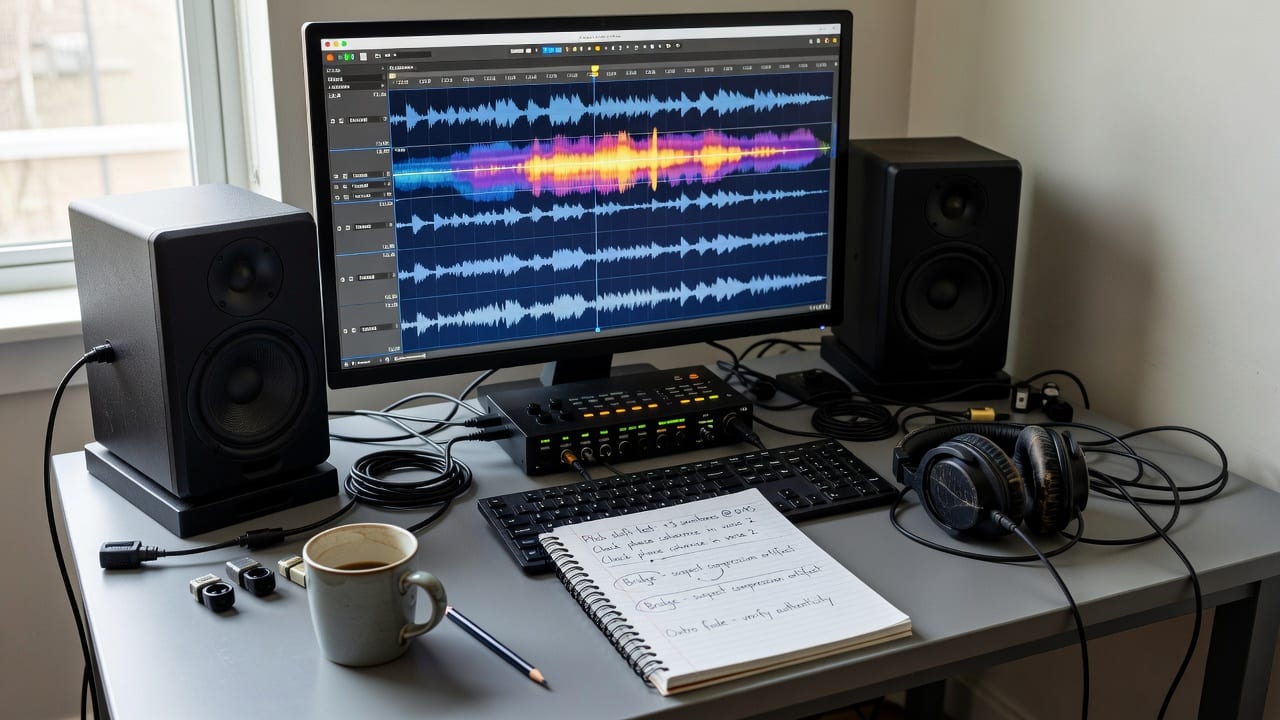
A grounded view of audio analysis work before writing an editorial pitch.
Quick Answer
Use audio analysis to prove track authenticity and find your Star Moment for Spotify pitches.
Prerequisites: The 2026 Spotify Pitching Landscape
The 2026 streaming landscape requires independent artists to definitively prove their music is human-made. With over 150,000 tracks uploaded daily, Spotify curators actively filter out generative AI spam. Understanding how to navigate this high-volume environment is the first prerequisite for any successful release campaign. Curators no longer have the bandwidth to guess whether a track is authentic; they rely on clear signals from the artist.
For a deep dive into the technical requirements of modern submissions, The 2026 Guide to Audio Analysis for Spotify Editorial Pitches outlines exactly what curators look for when verifying track authenticity. Artists must approach the Spotify for Artists dashboard not just as a text box for their biography, but as a platform to present verifiable sonic data.
Core Concepts: AI Detection and the Authenticity Mandate
At the heart of a modern pitching strategy is proactive AI detection. PitchPlus audio analysis detects AI-generated tracks by examining spectral inconsistencies and unnatural transient responses common in generative audio. This technology allows artists to avoid pitching inauthentic music, or worse, being falsely flagged as AI due to over-processed vocals or synthetic loops. By analyzing the audio file before submission, creators ensure their sonic profile reads as definitively human.
Instead of relying on generic text prompts to write their pitches, creators must use this hard data. The 2026 Guide to Using AI for Spotify Editorial Pitching highlights how utilizing audio-analysis AI differs entirely from pasting generic ChatGPT templates into your submission form. The former provides unique, track-specific insights, while the latter signals a lack of effort to editorial teams.
Practical Application: Finding Your Star Moment
Once authenticity is verified, the next step is capturing curator attention within the first 15 seconds of playback. This is where the Star Moment hook finder becomes critical. By analyzing acoustic energy, dynamic range, and frequency density, PitchPlus identifies the exact timestamp where your track peaks in engagement. This removes the guesswork from deciding which part of the song is the most compelling.
Curators appreciate artists who respect their time by pointing them straight to the best part of the record.
Advanced Techniques: Moving Beyond Free Templates
Advanced pitchers in 2026 have abandoned generic text formulas in favor of sonic data. When you compare paid audio analysis vs free Spotify pitch templates, the difference in editorial playlist placement rates is stark. Free templates produce identical, easily ignored pitches that fail to capture the unique sonic identity of a record. They rely on vague adjectives rather than concrete musical attributes.
Audio analysis provides unique, track-specific data points—such as exact BPM, key, and mood markers—that align perfectly with specific editorial ecosystems like 'Lorem' or 'Pollen.' By mapping the exact frequency response and rhythm structure of your track to the historical data of a target playlist, you transition from blindly submitting music to executing a targeted A&R strategy.
Expert Tips: Structuring the Final Pitch
Hard data gets you past the initial filters, but the human element secures the placement.
Mention the specific analog gear used, the real-world inspiration behind the lyrics, or the live musicians who contributed to the session. This hybrid approach—hard sonic data proving authenticity paired with a deeply human narrative—is the ultimate 2026 pitching strategy. It assures the curator that the track is safe to playlist while giving them a story to sell to their listeners.
1. AI Track Detection & Authenticity Verification
Spotify curators actively penalize generative AI spam in 2026, making verifiable human authenticity the primary gatekeeper for editorial consideration.
Run your final master through PitchPlus audio analysis to scan for spectral anomalies common in AI generation.
Generate an authenticity verification report to confirm the track's human origin.
Include a brief note in your pitch detailing the live instrumentation or specific DAW techniques used to reinforce the data.
2. Star Moment Hook Extraction
Editorial curators listen to an average of 12 to 15 seconds per submission; directing them to the track's peak engagement point prevents premature skips.
Process your track using the PitchPlus Star Moment hook finder to identify the exact timestamp of peak acoustic energy.
Format your Spotify for Artists pitch to lead with this timestamp (e.g., 'Skip to 0:45 for the main hook').
Ensure the 10 seconds following the Star Moment timestamp deliver the highest dynamic impact of the song.
3. Data-Driven Genre & Mood Alignment
Misclassifying a song's micro-genre or mood results in immediate rejection, whereas matching sonic markers to specific playlists increases placement odds.
Extract exact BPM, key, and mood markers using audio analysis tools.
Cross-reference these sonic data points with the current tracks on your target Spotify editorial playlist.
Use the exact terminology from your analysis (e.g., 'dark synthwave with 120 BPM driving bass') in the pitch description.
Frequently Asked Questions
How does audio analysis detect AI-generated music?
Audio analysis tools like PitchPlus detect AI-generated music by scanning for spectral anomalies, phase alignment issues, and unnatural transient responses that are characteristic of generative AI models, distinguishing them from human-produced tracks.
What is a Star Moment in a Spotify pitch?
A Star Moment is the exact timestamp in a song where acoustic energy and engagement peak. Identifying this hook allows artists to direct Spotify curators straight to the most compelling part of the track, saving them time and reducing skip rates.
Why are free Spotify pitch templates ineffective in 2026?
Free pitch templates are heavily overused and rely on generic adjectives. In 2026, curators look for specific sonic data, authenticity verification, and precise timestamps—elements that only custom audio analysis can provide.
Can I use AI to help write my Spotify editorial pitch?
Yes, but you should use audio-analysis AI to extract data about your song's BPM, mood, and hooks, rather than using generative text AI (like ChatGPT) to write a generic, inauthentic pitch description.