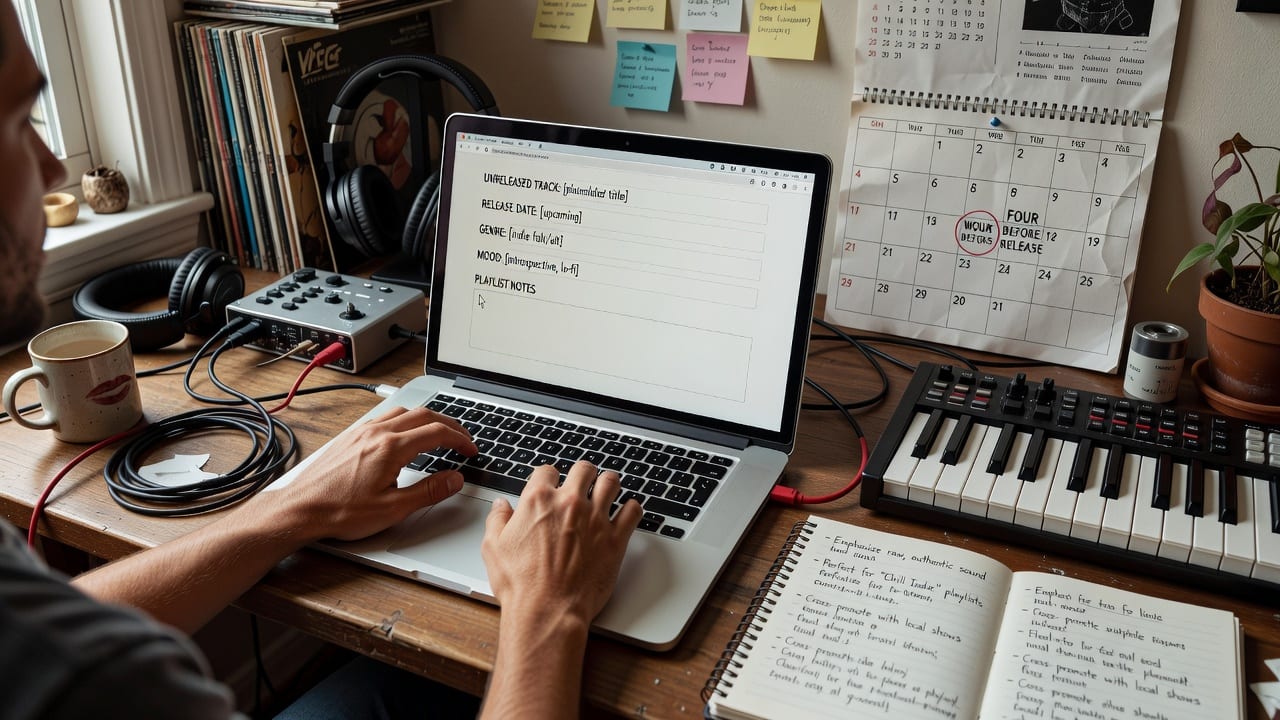
How Indie Artists Can Successfully Submit Music to Spotify Playlists in 2026
With over 120,000 tracks uploaded daily, only artists who pitch four weeks early and leverage post-release data consistently land on Spotify playlists.
A grounded pre-release pitching workflow, from timing to curator-ready track details.
Quick Answer
To successfully submit music to Spotify playlists, pitch unreleased tracks via Spotify for Artists at least four weeks early. Post-release, target independent curators using data-driven tools like PitchPlus to match your track's sonic profile with active, high-engagement playlists, avoiding generic mass-email campaigns.
Prerequisites: Mastering the Pre-Release Editorial Pitch
Submitting music to Spotify's in-house editorial team requires strict adherence to timeline prerequisites. While the Spotify for Artists dashboard technically allows submissions up to seven days before release, relying on this minimum window is a critical error for indie artists. Distributors require time to process metadata, and Spotify's editorial team plans their flagship playlists weeks in advance.
Understanding the 4-week rule is the foundation of a successful pre-release strategy. Submitting a track 28 days prior to release ensures it is fully ingested into Spotify's backend, giving curators ample time to review the submission. This lead time also guarantees the track's inclusion in your followers' Release Radar playlists, a vital algorithmic trigger that occurs automatically when a pitch is filed correctly.
The pitch itself must be concise and data-rich. Editors sift through thousands of submissions daily; they do not have time for generic artist biographies. A successful pitch highlights the track's specific sub-genre, mood, instrumentation, and the marketing budget or social momentum driving the release. Artists looking to master this format should study the anatomy of Spotify editorial pitches that achieve playlist placement, focusing on objective descriptors rather than subjective claims about the song's quality.
Editorial placement is highly competitive, making algorithmic playlists the most reliable growth engine for independent artists.
Editorial placement is highly competitive, making algorithmic playlists the most reliable growth engine for independent artists. Playlists like Discover Weekly, Release Radar, and Spotify Radio are not curated by humans; they are driven by user behavior metrics. The algorithm evaluates a track's save rate, skip rate, and completion rate within the first 48 hours of release to determine its viability for broader distribution.
To trigger these algorithmic recommendations, artists must drive high-intent traffic to their Spotify profiles on release day. Pre-save campaigns, while historically popular, are only effective if those users actually listen to the track on day one. A pre-save that results in a skipped track signals negative engagement to the algorithm. Instead, focus on converting core fans into active listeners who will save the track to their personal libraries and listen all the way through.
The value of playlist pitching extends beyond immediate streams; it builds your profile's authority score. When your track is placed on niche, highly engaged user playlists, Spotify's algorithm learns exactly which demographic enjoys your music. This data allows the platform to confidently serve your track to similar users via Discover Weekly, creating a compounding effect that sustains streams long after the initial release week.
The most vulnerable phase for an indie artist occurs roughly two weeks post-release. The initial marketing push has subsided, editorial playlists may not have materialized, and algorithmic momentum begins to wane. This post-release frustration point is where traditional pitching strategies fail, as artists often resort to spamming generic independent curators with copy-pasted emails.
Overcoming this plateau requires a shift from volume-based pitching to precision targeting. Independent curators manage highly specific ecosystems—a "Late Night Lo-Fi" curator will instantly reject a high-BPM synthwave track, regardless of its production quality. Finding the exact right home for a track manually is incredibly time-consuming and prone to error.
This is where intelligent tools become essential. PitchPlus operates as a complementary intelligence layer, analyzing your track's sonic profile and recommending the exact platforms and curators that match your specific sound. By utilizing a smart playlist finder, artists eliminate the guesswork of post-release outreach. Instead of sending 100 blind emails, you send 10 highly targeted pitches to curators whose historical data proves they playlist tracks with your exact BPM, energy level, and genre tags.
Practical Application: Crafting the Perfect Independent Pitch
When reaching out to independent curators, the communication strategy differs significantly from the Spotify for Artists dashboard. Independent curators are music fans first; they respond to authenticity and mutual value. A cold email that simply says "check out my new song" offers no value to the curator and demonstrates a lack of research into their specific playlist.
A professional independent pitch acknowledges the curator's specific taste. Reference a track they recently added to their playlist, explain exactly why your song fits that same sonic landscape, and offer to share their playlist with your own audience. This collaborative approach transforms a transactional request into a networking opportunity.
For those refining their outreach, understanding the 2025 Spotify editorial pitching process provides a strong framework for independent pitches as well. The core principles remain the same: be concise, be relevant, and lead with data. Whether you are pitching to a Spotify editor in Stockholm or an independent curator in Brooklyn, clearly articulating your track's mood, genre, and target audience is the key to securing placement.
1. The 4-Week Editorial Lead
Spotify editors require significant lead time to review thousands of tracks and slot them into upcoming playlist schedules. Submitting four weeks early also guarantees inclusion in algorithmic Release Radar playlists.
Finalize audio masters and artwork at least 6 weeks before your target release date.
Upload the release to your distributor immediately to allow for 2 weeks of backend processing.
Submit the pitch via Spotify for Artists exactly 28 days before release, filling out all mood, genre, and instrumentation tags accurately.
2. Algorithmic Seeding
Spotify's algorithm relies on day-one engagement metrics—specifically save rates and low skip rates—to determine if a track should be pushed to Discover Weekly and Spotify Radio.
Run targeted social media campaigns directing core fans to listen on release day.
Incentivize fans to save the track to their personal libraries rather than just streaming it once.
Avoid broad, untargeted ad campaigns that drive low-intent listeners who are likely to skip the track within the first 30 seconds.
3. Intelligent Post-Release Targeting
Mass-emailing generic independent curators results in low placement rates and wasted time. Data-driven sonic matching ensures pitches are only sent to curators actively seeking your specific sound.
Wait until the initial release week momentum settles to assess your track's organic performance.
Utilize PitchPlus as a complementary intelligence layer to identify independent playlists that match your track's exact BPM, genre, and mood.
Send personalized pitches to this refined list of curators, referencing specific tracks already on their playlists to prove fit.
Frequently Asked Questions
Does it cost money to pitch to Spotify editorial playlists?
No. Pitching to Spotify's official editorial team is completely free and can only be done through the Spotify for Artists dashboard. Any third-party service claiming they can guarantee editorial placement for a fee is a scam and violates Spotify's terms of service.
What happens if I miss the 4-week pitching window?
If you miss the 4-week window, you can still submit your pitch up to 7 days before release. However, you severely reduce the chances of editorial review, as curators plan weeks in advance. You also risk missing the cutoff to guarantee your track appears on your followers' Release Radar.
How do I find the right independent Spotify playlist curators?
Finding the right independent curators requires matching your track's sonic data with the curator's historical playlist additions. Using a smart playlist finder like PitchPlus acts as an intelligence layer, analyzing your music and recommending the exact curators who are actively seeking your specific sub-genre and mood.
Why did my track get removed from an algorithmic playlist?
Algorithmic playlists like Discover Weekly are dynamic and update based on real-time user data. If your track experiences a sudden spike in skip rates or a drop in completion rates, the algorithm will automatically cycle it out in favor of tracks with higher engagement metrics.