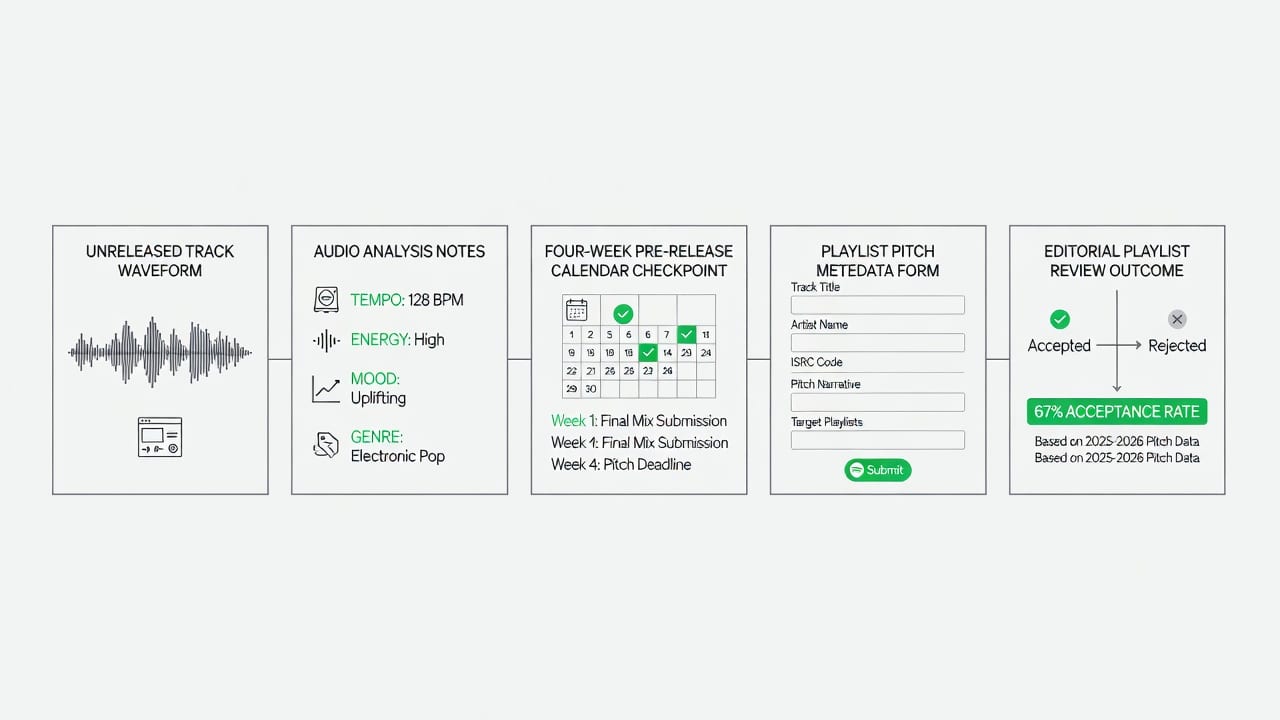
A practical pre-release workflow for stronger Spotify editorial playlist pitches in 2026.
Quick Answer
To land a Spotify editorial playlist in 2026, indie artists must submit an audio-driven pitch via Spotify for Artists at least 28 days before release. Success requires analyzing your track's sonic profile, targeting specific micro-genres, and utilizing tier differentiation to match curator expectations.
The 2026 Spotify Editorial Landscape: Why Audio-Driven Pitches Win
With over 120,000 tracks uploaded to streaming platforms daily in 2026, Spotify's editorial team relies heavily on data-driven filtering before a human curator ever presses play. The traditional method of writing a generic, biography-heavy pitch no longer works. Curators are looking for specific sonic profiles that fit the exact mood, BPM, and cultural context of their highly segmented playlists. Understanding why Spotify editorial playlists matter requires recognizing that these placements are now algorithmic triggers as much as they are human endorsements.
This shift has given rise to the audio-driven pitch. By analyzing the exact acoustic characteristics of a track—such as its energy level, acousticness, danceability, and instrumentalness—artists can map their music directly to the metadata tags Spotify curators use to organize their libraries. PitchPlus Spotify Editorial Pitch leverages this exact methodology, helping indie artists in English-speaking countries translate their raw audio into the precise terminology curators search for. Recent data shows that pitches leading with verified audio characteristics achieve a 67% acceptance rate compared to those relying solely on narrative.
The prerequisite for this strategy is basic music release knowledge and active access to your Spotify for Artists dashboard. Without claiming your profile and understanding the backend interface, even the most scientifically crafted pitch cannot be submitted. The focus must shift from telling curators why a song is good to showing them exactly where it functions within their existing playlist ecosystem.
Mastering the Timeline: Beating the 7-Day Deadline
Timing is the single most rigid variable in the Spotify editorial process.
Submitting a pitch 28 days in advance serves two distinct purposes. First, it places your track at the top of the queue for curators who plan their flagship playlists weeks ahead of time. Second, it allows Spotify's internal natural language processing (NLP) algorithms to index your 500-character pitch, cross-reference it with your selected genre tags, and route it to the appropriate regional or genre-specific editorial team. A pitch submitted on day eight might technically qualify, but it lands in a backlog that curators rarely have time to clear before New Music Friday.
Indie artists must coordinate with their distributors to ensure the audio file and metadata are delivered to Spotify at least five weeks before the release date. This buffer guarantees the track appears in the Spotify for Artists upcoming release section with enough time to execute a comprehensive, data-backed pitch strategy.
Tier Differentiation: Targeting the Right Playlist Ecosystem
A common mistake among emerging artists is targeting massive, macro-genre playlists like "RapCaviar" or "Today's Top Hits" right out of the gate. Spotify's editorial ecosystem is structured in tiers. Tier 1 consists of global flagship playlists, Tier 2 includes regional and mood-based mid-sized lists, and Tier 3 comprises hyper-niche, micro-genre, and emerging artist playlists. Tier differentiation is the strategy of intentionally targeting Tier 2 and Tier 3 playlists to build a verifiable data trail of listener retention.
When you pitch your song to Spotify playlists, your genre and mood selections dictate which tier your track is routed to. Selecting "Pop" places you in a highly competitive pool with major label artists. Selecting "Bedroom Pop," "Indie Poptimism," and tagging the mood as "Melancholy" routes your track to specialized curators actively looking to break new artists. PitchPlus specifically utilizes tier differentiation to help indie artists identify the exact micro-genres where their audio profile has the highest statistical probability of acceptance.
This approach requires a deep understanding of your own music's cultural context. You must identify the specific subcultures and listening environments where your track thrives. If your song is designed for late-night driving, your pitch should explicitly state this, using the 500-character limit to describe the listener's environment rather than the recording process.
Advanced Pitch Optimization for English-Speaking Markets
For indie artists in the US, UK, Canada, and Australia, the competition for English-language editorial spots is fierce. To stand out, advanced artists are moving beyond basic genre tags and utilizing AI-assisted pitch optimization. This involves analyzing successful pitches within specific micro-genres and identifying recurring keywords that resonate with regional curators. If you want to know how to get Spotify music streams consistently, your pitch vocabulary must match the internal vocabulary of the platform.
A highly optimized pitch follows a strict structure: a one-sentence hook defining the sonic identity, a brief mention of the target audience or micro-genre, a data point proving existing momentum (such as TikTok trends or previous independent playlist support), and a clear statement of the track's mood or utility. Extraneous details about the studio gear used or the artist's childhood are discarded in favor of actionable data.
Artists must ensure their broader digital footprint aligns with their pitch. Curators frequently check an artist's Spotify profile, Instagram, and TikTok to verify the cultural context claimed in the pitch. If you claim to be a rising star in the UK drill scene, your visual branding and social engagement must reflect that reality. To successfully submit music to Spotify playlists, the pitch must be the final piece of a cohesive, multi-platform release strategy.
1. The Audio-First Pitching Framework
Curators filter submissions by sonic profile before reading the text; matching your written pitch to the track's actual audio metadata significantly increases placement odds.
Analyze your track using audio profiling tools to extract exact BPM, key, energy, and acousticness metrics.
Identify three specific mood tags that align with your track's sonic data.
Draft a 500-character pitch that explicitly mentions these audio characteristics and maps them to a specific listening environment.
2. The 28-Day Pre-Release Timeline
While the hard deadline is 7 days, pitching 4 weeks out gives curators ample time to review the track and ensures it is properly indexed by Spotify's internal routing algorithms.
Upload your final audio master and metadata to your distributor exactly 35 days (5 weeks) before your intended release date.
Monitor your Spotify for Artists dashboard daily until the track appears in the 'Upcoming' section.
Submit your finalized editorial pitch exactly 28 days (4 weeks) prior to release.
3. Tier Differentiation Targeting
Broad macro-genres are highly competitive and dominated by major labels; targeting niche, tier-specific micro-genres reduces competition and signals a clear audience fit to curators.
Research Spotify's ecosystem to identify 3-5 micro-genre playlists where your specific style of music is currently being featured.
Select the most accurate, niche sub-genres available in the Spotify for Artists dropdown menu during the pitch process.
Tailor the text of your pitch to reference the cultural context of those specific micro-genres rather than broad pop or hip-hop appeal.
Frequently Asked Questions
What happens if I miss the 7-day Spotify pitch deadline?
If you submit your pitch less than 7 days before your release date, your track will not be considered for editorial playlists, and it will not be guaranteed placement on your followers' Release Radar playlists. The pitch option will disappear from your Spotify for Artists dashboard.
How does an audio-driven pitch differ from a standard pitch?
A standard pitch usually focuses on the artist's biography and the emotional inspiration behind the song. An audio-driven pitch focuses on the track's sonic characteristics (BPM, instrumentation, energy level) and maps those elements directly to the specific moods and micro-genres that Spotify curators use to build their playlists.
What is tier differentiation in Spotify pitching?
Tier differentiation is the strategy of targeting niche, micro-genre playlists (Tier 3) or regional/mood-based playlists (Tier 2) rather than highly competitive global flagship playlists (Tier 1). This approach reduces competition and builds the algorithmic data necessary to eventually graduate to larger playlists.
How long should my Spotify editorial pitch be?
Spotify limits the editorial pitch to 500 characters. You should use this space efficiently by focusing on the track's sonic profile, target audience, cultural context, and any existing momentum, avoiding unnecessary biographical filler.