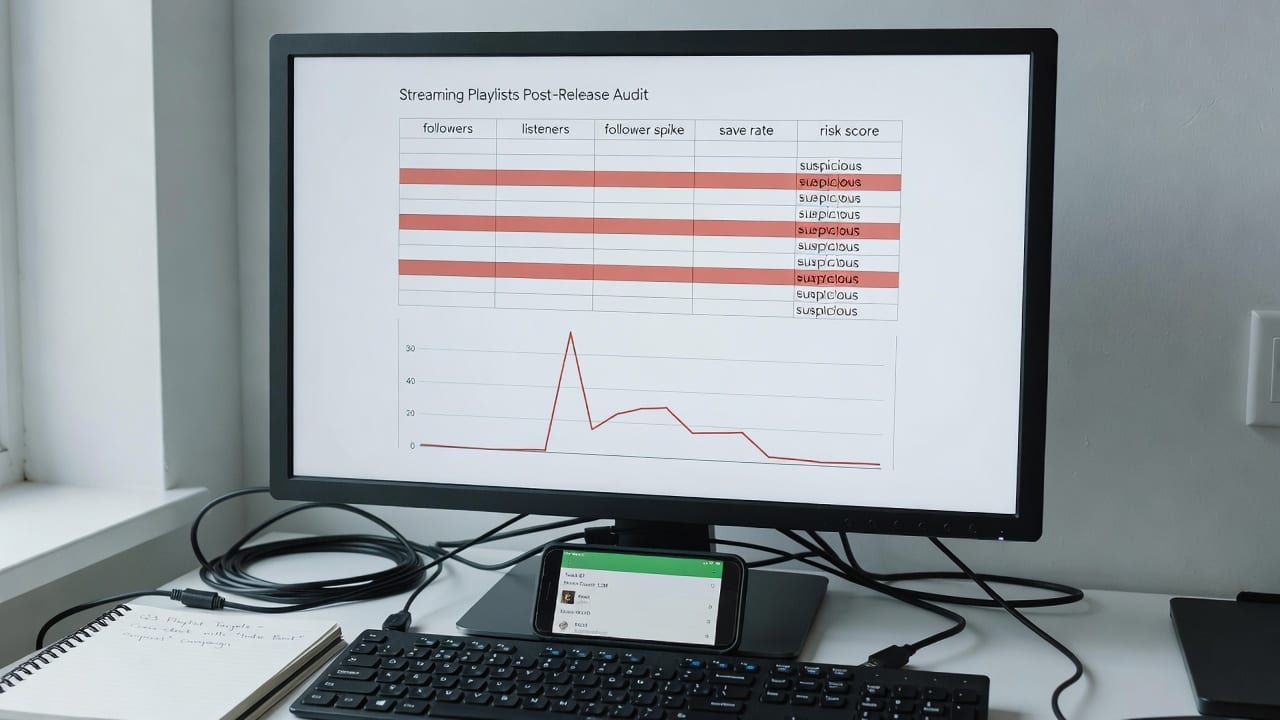
A practical playlist audit focuses on growth spikes, audience geography, and quality signals before pitching.
Quick Answer
Detect fake Spotify playlists by analyzing follower growth curves, checking listener locations, and using upstream intelligence tools to score playlist quality before spending credits on SubmitHub or Groover.
Prerequisites: Understanding the Cost of Bot Streams
Post-release artists often rush straight from their distributor to pitching platforms, armed with a budget and a desire for immediate streams. Before spending a single dollar on SubmitHub or Groover, you must understand the mechanical consequences of landing on a fake playlist. Spotify's algorithm relies on user data to categorize and recommend your music. When a bot farm streams your track, it feeds the algorithm garbage data.
Core Concepts: The Fake Playlist Economy
To effectively filter out bad actors, you need to understand why fake playlists exist. The current music promotion ecosystem incentivizes follower counts over actual engagement. Curators on platforms like SubmitHub and Groover charge artists a micro-fee (usually $1 to $3) to review a track. To get approved as a premium curator on these platforms, they need playlists with thousands of followers.
Instead of spending years organically building an audience through targeted ads and community engagement, bad actors buy fake followers for pennies. They then use these inflated numbers to pass the initial vetting processes of pitching platforms. Once approved, they collect review fees from unsuspecting artists. The playlist itself generates no real listeners, meaning the artist pays for a placement that yields zero algorithmic benefit. This is why detecting fake Spotify playlists before you pitch is the most critical step in modern music marketing.
Practical Application: Manual Detection Metrics
1. Check follower growth curve
Organic playlists grow steadily over time, with minor fluctuations. Bot-farmed playlists exhibit "staircase" growth: flatlining for weeks, followed by a vertical spike of 5,000 followers in a single day, then flatlining again.
2. Audit the Discovered On section
If a playlist has 50,000 followers but does not appear in the top five "Discovered On" sources for an artist placed in its top ten slots, the playlist is dead.
3. Review geographic data
If an indie folk artist suddenly has 8,000 monthly listeners from a single obscure town in Finland, they are likely the victim of a localized bot farm.
Next, audit the "Discovered On" section of the artists currently featured on the playlist. If a playlist has 50,000 followers but does not appear in the top five "Discovered On" sources for an artist placed in its top ten slots, the playlist is dead. Furthermore, check the geographic data. If an indie folk artist suddenly has 8,000 monthly listeners from a single obscure town in Finland, they are likely the victim of a localized bot farm. Identifying these red flags manually is essential for wasting SubmitHub credits on dead ends.
Advanced Techniques: The Upstream Intelligence Layer
While manual detection works, it is entirely unscalable. An artist cannot spend four hours auditing data for every ten pitches. This bottleneck is where advanced automation becomes necessary. Instead of treating pitching platforms as discovery engines, artists must treat them strictly as transaction layers. The discovery and vetting must happen upstream.
Professional music marketers operate on a strict filter first, pitch second methodology.
Expert Tips: Protecting Your Promotion Budget
Professional music marketers operate on a strict "filter first, pitch second" methodology. Never rely on the internal search engines of pitching platforms to gauge quality, as their primary metric is often curator responsiveness rather than listener authenticity. Always cross-reference a curator's Spotify profile. Real curators link their Instagram, Twitter, or personal websites. Fake curators hide behind generic stock photos and offer no external contact methods.
Additionally, monitor the track turnover rate. A healthy playlist updates regularly, cycling tracks in and out to keep listeners engaged. If a playlist has maintained the exact same 50 tracks for six months but claims to have 20,000 active daily listeners, the math does not align. Protect your budget by demanding transparency from the data before you initiate contact.
1. Upstream Intelligence Filtering
Automates the detection of bot patterns and dead engagement across thousands of playlists, preventing budget waste on transaction layers like SubmitHub.
Input your specific sub-genre into an upstream intelligence tool like PitchPlus Smart Playlist Finder.
Apply filters to exclude playlists with a quality score below the acceptable threshold for organic engagement.
Export the pre-vetted list of high-scoring curators and use it as your exclusive target list for paid pitching platforms.
2. Follower-to-Listener Ratio Auditing
Real playlists maintain a predictable ratio of followers to active listeners; bot playlists feature massive follower counts with zero actual stream generation.
Identify a mid-tier artist currently placed in the top 10 positions of your target playlist.
Navigate to that artist's Spotify profile and check their 'Discovered On' section.
If the target playlist does not appear in their top sources despite having tens of thousands of followers, discard the playlist immediately.
3. Geographic Anomaly Detection
Bot farms are frequently hosted in specific, low-cost server locations, resulting in highly concentrated, unnatural listener demographics that trigger Spotify's algorithmic penalties.
Review the 'Where People Listen' section for artists featured heavily on the target playlist.
Flag any playlist driving 80% or more of its traffic from a single, non-major city that does not align with the artist's touring or marketing history.
Avoid pitching to any curator associated with these geographic anomalies to protect your track from artificial streaming strikes.
Frequently Asked Questions
What happens if my song gets placed on a fake Spotify playlist?
If your song lands on a fake playlist, it will accumulate artificial streams generated by bots. Spotify's algorithm detects these unnatural listening patterns and will issue an artificial streaming strike. Multiple strikes can lead to your track being removed from the platform entirely, and your distributor may terminate your account.
How do fake playlist curators get approved on SubmitHub or Groover?
Bad actors purchase fake followers to artificially inflate their playlist numbers. Because pitching platforms often use follower counts as a primary metric for initial approval, these fake playlists slip through the cracks. Once approved, the curators collect review fees from artists without providing any real listener engagement.
What is an upstream intelligence layer in music marketing?
An upstream intelligence layer is a data analysis step taken before spending money on pitching platforms. Tools like PitchPlus Smart Playlist Finder act as this layer by automatically scoring playlists for authenticity, follower growth patterns, and engagement, ensuring you only pitch to real, active curators.
Can I manually check if a Spotify playlist is botted?
Yes, though it is time-consuming. You can manually check by looking at the follower growth curve for unnatural vertical spikes, auditing the 'Discovered On' section of artists on the playlist to see if it actually generates streams, and checking for bizarre geographic concentrations in listener data.