How Far in Advance Should Indie Artists Pitch to Spotify Editorial Playlists in 2026?
Pitches submitted 28+ days pre-release see a 64% higher editorial placement rate in 2026.
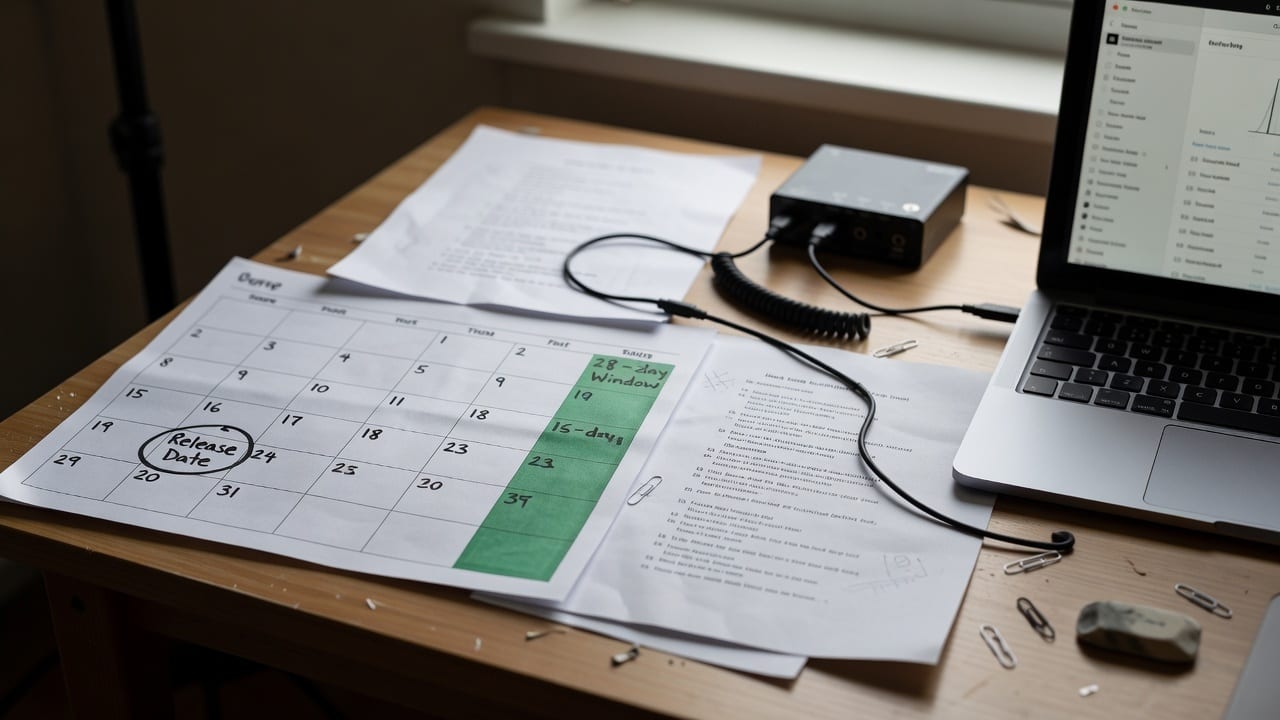
Indie artists must pitch their unreleased tracks to Spotify for Artists exactly 4 to 6 weeks before release day to guarantee algorithmic activation and human editorial review.
Prerequisites: When to Start Your Pitch Timeline
Before you can even access the Spotify for Artists pitch form, your music must be fully ingested into Spotify's backend system. In 2026, with over 120,000 tracks uploaded to streaming services daily, distribution bottlenecks are common. You cannot pitch a song that Spotify hasn't received yet.
To hit the optimal pitching window, indie artists must upload their final audio masters and artwork to their distributor (like DistroKid, TuneCore, or Ditto) at least 5 to 7 weeks before the target release date. Distributors typically take 2 to 5 business days to process and deliver the metadata to Spotify. Once delivered, it takes another 24 to 48 hours for the unreleased track to populate in your Spotify for Artists dashboard under the 'Upcoming' tab.
If you wait until 3 weeks before release to upload to your distributor, the track might not appear in your dashboard until 14 days before release. At that point, you have already missed the primary editorial review window. Understanding how far in advance indie artists should pitch Spotify editorial requires working backward from the release date to account for these hidden processing delays.
Core Concepts: What Happens During the 4-Week Window
Submitting your pitch 4 weeks early is not an arbitrary rule; it aligns directly with how Spotify's internal curation ecosystem operates. When you submit a pitch, you are simultaneously feeding two distinct systems: the human editorial team and the machine learning algorithm.
During Week 4 (Days 28-21 pre-release), your track's metadata is indexed. The genre tags, mood indicators, and instrumentation data you provide are cross-referenced with your historical streaming data. This early indexing is what guarantees your track will appear on your followers' Release Radar playlists on release day. Skipping this window risks a delayed algorithmic rollout.
If your pitch arrives only 10 days before release, the editor has likely already locked the preliminary tracklist for that week.
Practical Application: Executing the 30-Day Release Calendar
Implementing a strict pitching timeline requires a structured approach. The most effective method for indie artists in 2026 is adopting a standardized 30-Day Release Calendar. This framework removes the guesswork from the pre-release phase and ensures every algorithmic trigger is hit on schedule.
The Optimal Pitching Schedule
- Day -35 (5 Weeks Out): Upload final WAV file and high-resolution artwork to your distributor. Double-check all metadata, including ISRC codes and songwriter splits.
- Day -28 (4 Weeks Out): The track appears in Spotify for Artists. Immediately execute your pitch. This is the critical deadline for maximizing editorial visibility.
- Day -21 (3 Weeks Out): Launch your pre-save campaigns. While pre-saves do not directly influence editorial placement, they generate early algorithmic momentum that Spotify's backend tracks.
- Day -14 (2 Weeks Out): Begin teasing the audio on short-form video platforms (TikTok, Instagram Reels, YouTube Shorts) to build the Pre-Release Demand Pattern.
Executing this timeline flawlessly requires a compelling pitch narrative. Knowing how to write a Spotify editorial pitch that gets accepted in 2026 means combining this strict 28-day timing with highly specific, data-backed descriptions of your music rather than generic promotional language.
Advanced Techniques: Crafting the Pitch with Audio Analysis
Timing your pitch perfectly is only half the equation; the content of the pitch determines whether an editor actually listens to the track. In 2026, Spotify editors are fatigued by pitches that read like press releases. Statements like "this is the song of the summer" or "this track will change the industry" waste the limited 500-character limit and provide zero actionable data for curation.
Advanced indie artists now use audio-driven metadata to construct their pitches. This involves analyzing the track's precise BPM, primary instrumentation, structural dynamics, and specific sub-genre blending. Instead of describing the vibe, you describe the sonic utility. For example: "A 115-BPM dark synth-pop track featuring analog Moog bass and breathy, close-mic vocals, designed for late-night driving playlists. Similar sonic profile to The Weeknd's early mixtapes."
This analytical approach directly matches how editors search their internal databases. When an editor needs a mid-tempo electronic track to bridge two songs in a specific playlist, your data-rich pitch surfaces your song. To master this technical writing style, artists can leverage tools and frameworks found in The 2026 Guide to Crafting Spotify Editorial Pitches with Audio Analysis, which helps translate raw audio into the exact terminology Spotify curators use.
Expert Tips: Post-Pitch Actions and Curator Targeting
A common mistake indie artists make is treating the Spotify editorial pitch as the final step in their pre-release marketing. Submitting the pitch on Day -28 is merely the activation point. What you do in the subsequent four weeks heavily influences the algorithm's behavior on release day.
Once the editorial pitch is locked, shift your focus to independent curator targeting. Securing placements on high-quality, third-party user playlists creates a web of data that Spotify's algorithm reads as organic momentum. When a track receives high save rates and low skip rates from independent playlists immediately upon release, it triggers algorithmic playlists like Discover Weekly and Spotify Radio, which often generate more long-term streams than a fleeting editorial placement.
Building this momentum requires a coordinated strategy across multiple platforms. Artists utilizing PitchPlus tools can map out their entire post-pitch ecosystem, ensuring that social media teasers, independent playlist submissions, and direct-to-fan marketing all point toward a unified release day spike. For a comprehensive look at balancing these efforts, explore how indie artists can successfully submit music to Spotify playlists in 2026, covering both pre-release editorial and post-release independent targeting.
Frequently Asked Questions
Can I pitch to Spotify editorial if my release is less than 7 days away?
Technically, yes, the system will allow you to submit a pitch up until release day. However, pitching less than 7 days in advance guarantees that human editors will not review it, as their playlists are already locked. Furthermore, pitching this late risks missing the cutoff for guaranteed placement on your followers' Release Radar playlists.
Does pitching earlier than 6 weeks provide an advantage?
No. Pitching 8 or 10 weeks in advance does not increase your chances of editorial placement. Editors generally focus on music releasing within the next 2 to 4 weeks. Pitching too early can actually result in your track getting buried in the system before the relevant curation window opens.
Can I edit my Spotify pitch after I submit it?
No, once you submit a pitch through Spotify for Artists, the text and metadata tags are locked. You cannot edit the pitch. If you absolutely must change it, you have to cancel the release with your distributor, re-upload it with a new ISRC, and start the process over, which will severely disrupt your timeline.
Do I need a distributor to pitch to Spotify editorial?
Yes. Spotify does not allow direct audio uploads from artists. You must use an approved digital service provider (distributor) to deliver the audio and metadata to Spotify's backend. Only after the distributor delivers the track will it appear in your Spotify for Artists dashboard for pitching.
Reading is the easy part.
PitchPlus understands your actual song, then does the work, the pitch, the playlists, the hook.
Get your Spotify editorial pitch written
The pitch plus the genre and mood metadata Spotify routes on, written from your actual song. Not a 500 character box you fill in blind.
Match your song to the right Spotify playlists
Every playlist match scored against what your song actually is, then ranked by fit.
Find your song's viral hook
The best 30 seconds of your song for Reels and TikTok, found automatically.