How AI Detects Music Genres from Audio for Authentic Pitches
Audio-first AI genre detection achieves over 90% accuracy.
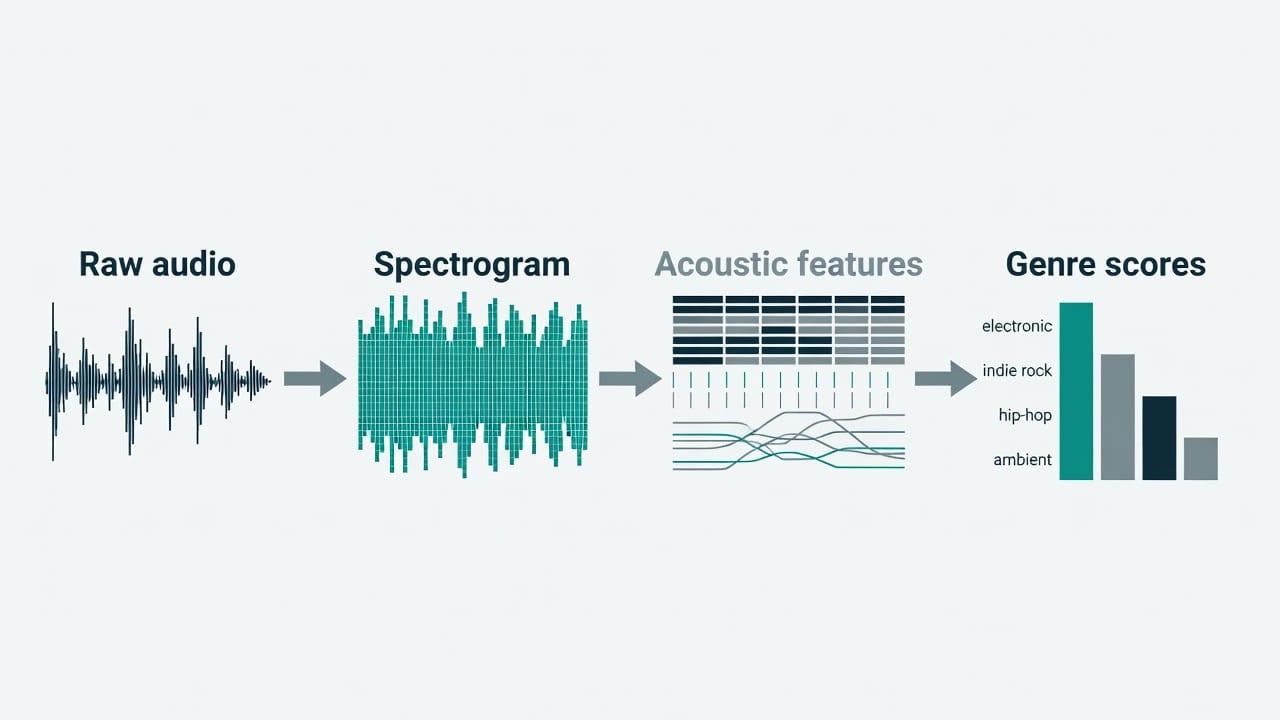
Audio-first AI analyzes raw waveforms to identify exact sub-genres, enabling highly authentic 500-character pitches.
The Shift from Metadata to Audio-First Analysis
Pre-release artists frequently struggle to define their own sound objectively. When preparing for a release, musicians often rely on subjective text-based metadata or generic genre tags that fail to capture the nuance of their tracks. This subjective tagging leads to misaligned pitches, causing Spotify editorial teams and independent curators to reject submissions that do not fit their specific sonic requirements.
The transition to Understanding AI Music Analysis marks a critical shift in how music is categorized. Instead of asking an artist to guess their micro-genre, audio-first systems evaluate the actual audio waveforms. This process ignores user-inputted text and focuses entirely on tempo, key, instrumentation, and energy. By analyzing the raw signal, the technology removes human bias, ensuring the track is categorized exactly as a curator will hear it.
This objective analysis is a strict prerequisite for modern playlist pitching. Artists attempting to secure placements on highly competitive platforms must know their exact primary and secondary genres before drafting a single word of their pitch. Relying on outdated ID3 tags or broad categories like 'Pop' or 'Electronic' guarantees the track will be buried under thousands of more accurately targeted submissions.
How AI Processes Raw Audio Signals
The technical process of identifying a genre begins by converting an uncompressed audio file into a visual format. Algorithms transform the raw MP3 or WAV file into a spectrogram, which maps the frequencies and amplitudes of the track over time. This visual representation allows machine learning models to 'see' the music, breaking down complex sonic structures into quantifiable data points.
Once the spectrogram is generated, Convolutional Neural Networks (CNNs) scan the image to extract specific features. The most critical of these are Mel-frequency cepstral coefficients (MFCCs), which represent the short-term power spectrum of the sound. These coefficients act as a sonic fingerprint, capturing the unique timbre and rhythmic patterns of the instrumentation. For a deeper technical breakdown, exploring How AI Detects Music Genres from Raw Audio Signals reveals how these models differentiate between closely related sub-genres.
The final step involves classification against a massive taxonomy. The AI compares the extracted features against a database of over 700 distinct micro-genres. If a track features the heavy sub-bass of trap but the atmospheric synthesizers of dream pop, the classification model calculates the exact percentage match for each category, outputting a highly precise genre profile that forms the foundation of an authentic pitch.
Applying Genre Detection to Your Pitch Strategy
1. Export your final mix as WAV
Export the final, unmastered or mastered mix as a high-quality WAV file. Compressing the file too early can strip away high-frequency data that algorithms use to detect subtle instrumentation.
2. Run the audio through a dedicated analysis tool
Feed the audio into a dedicated analysis tool such as the Free Music Genre Finder. Upload your file and receive immediate, data-backed primary and secondary genre tags.
3. Map the detected tags into your pitch
Map these detected tags directly into the pitch. When submitting to Spotify for Artists, lead with the exact AI-verified micro-genres so the editorial team sees the track belongs in a specific ecosystem.
Next, the artist feeds the audio into a dedicated analysis tool. Using a Free Music Genre Finder allows the creator to upload their file and receive immediate, data-backed primary and secondary genre tags. This step replaces the traditional method of polling friends or relying on broad distributor dropdown menus. The output provides the exact terminology that playlist curators actively search for.
The final step is mapping these detected tags directly into the pitch. When submitting to Spotify for Artists, the platform restricts pitches to 500 characters. Every word must carry weight. By leading the pitch with the exact AI-verified micro-genres, the artist immediately signals to the editorial team that the track belongs in a specific ecosystem. This precision prevents the pitch from sounding vague or overly promotional.
Handling Edge Cases with Advanced Ensemble Models
Modern independent music rarely fits neatly into a single category. Tracks that blend acoustic folk instrumentation with electronic drum programming create edge cases that confuse basic, single-layer algorithms. When a basic model encounters a hybrid track, it often defaults to a generic parent genre, stripping the music of its unique identity and ruining the specificity needed for a targeted pitch.
Advanced ensemble models solve this by running multiple parallel analyses on the same audio file. One neural network isolates and evaluates the rhythmic grid, identifying syncopation typical of Latin music. Simultaneously, a separate model analyzes the harmonic progression and vocal timbre, detecting the characteristics of indie pop. The ensemble system then weights these conflicting signals based on their prominence in the mix.
The result is a nuanced output that accurately reflects the hybrid nature of the track. Instead of labeling a song simply as 'Alternative', an ensemble model will identify it as 'Indie Pop with Latin Rhythm elements'. This level of granularity is exactly what curators need to confidently place a track in a mood-based or cross-genre playlist.
Why Audio Listening Outperforms Free Templates
The internet is saturated with free pitch templates that promise to help artists secure playlist placements. These tools operate on a simple Mad-Libs structure, asking the user to type in their genre, mood, and influences, which the software then formats into a generic paragraph. If the artist misidentifies their own genre at the input stage, the template simply amplifies that error, resulting in a polished but fundamentally inaccurate pitch.
This is the exact scenario where paying for a dedicated service proves its return on investment. PitchPlus Editorial Pitch solves the accuracy problem by actually listening to the audio. By utilizing PitchPlus: The Audio-First AI Tool for Authentic Playlist Pitching, artists bypass the risk of human error. The service generates a 500-character pitch based on the verifiable sonic qualities of the waveform, not the artist's subjective opinion.
Curators can immediately spot a template-generated pitch. They read thousands of submissions a week and quickly discard those that use generic buzzwords without accurately describing the music.
Frequently Asked Questions
Why is audio-first AI better than metadata for genre detection?
Audio-first AI analyzes the actual sound waves—tempo, key, instrumentation, and energy—rather than relying on text tags typed by the user. This removes human bias and ensures the genre accurately reflects what curators will actually hear.
How does PitchPlus Editorial Pitch differ from free pitch templates?
Free templates just rearrange the text you type into them. If you guess your genre wrong, the pitch is wrong. PitchPlus actually listens to your raw audio file to detect the exact sub-genre, generating a highly authentic 500-character pitch based on sonic reality.
What is a spectrogram in music AI?
A spectrogram is a visual representation of an audio signal, mapping frequencies and amplitudes over time. AI models use these images to 'see' the music and extract features like rhythm and timbre for accurate classification.
Why are 500-character pitches important for Spotify?
Spotify for Artists limits editorial pitches to 500 characters. Curators skim these rapidly, meaning every word must be precise. Using AI-verified micro-genres ensures the pitch is highly targeted and immediately communicates the track's exact vibe without wasted space.
Reading is the easy part.
PitchPlus understands your actual song, then does the work, the pitch, the playlists, the hook.
Get your Spotify editorial pitch written
The pitch plus the genre and mood metadata Spotify routes on, written from your actual song. Not a 500 character box you fill in blind.
Match your song to the right Spotify playlists
Every playlist match scored against what your song actually is, then ranked by fit.
Find your song's viral hook
The best 30 seconds of your song for Reels and TikTok, found automatically.